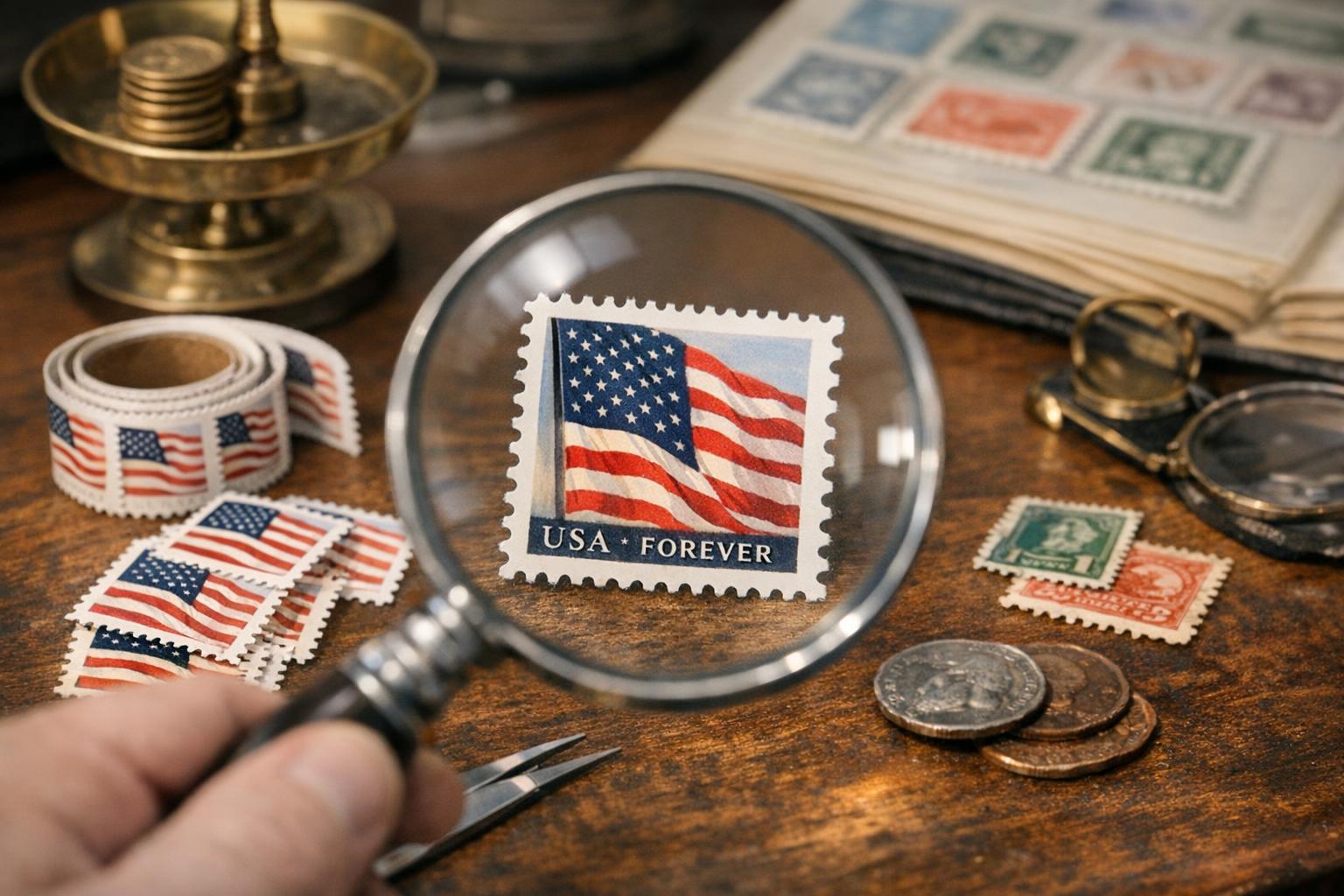
Forever stamps changed the basic math of mailing. You buy a single stamp and it pays First-Class postage no matter how rates climb. That practical simplicity is exactly why they matter to collectors — and why forever-stamp collectibility has become a distinct niche inside American philately.
## Forever-Stamp Collectibility: What Collectors Look For
The first thing to get straight is that forever-stamp collectibility isn’t the same as old-fashioned rarity. Most forever stamps are printed in huge quantities and used up quickly as everyday postage. Collectors who chase value are hunting for anomalies: printing errors, short-run specials, misperforations, and oddities that escaped quality control. Condition matters, but the story behind an item often matters more.
Collectors examine several concrete details when judging a forever stamp’s potential worth:
– Was it part of a small print run or a commemorative issue that sold out fast?
– Are there plate numbers, coil cuts, or se-tenant pairings that make particular units distinct?
– Did the stamp leave the post office unused (mint, with gum intact) or was it canceled in an unusual way?
– Is there an identifiable production error — color omissions, double impressions, skewed perforations?
All of that feeds the assessment of stamp collectibility in a modern context. For everyday issues the default is low market value. For items with genuine anomalies, prices can climb quickly among specialists.
### Why Forever Stamps Became Collectible
Forever stamps arrived in 2007 as a practical answer to rising rates: buy them once, use them forever. That functional angle is exactly what makes certain forever stamps collectible. When an issued design ends up being more scarce than anticipated, collectors latch on. The combination of modern production methods and mass distribution also creates new types of collectible mistakes — digital plate shifts, color separations that mis-register, and gum irregularities that older printing processes rarely produced.
Another point: collecting tastes have changed. Topical collecting has grown — people who collect birds, trains, civil rights themes or pop-culture icons will chase recent issues that match their themes. That drives demand for seemingly common stamps, and demand is the other half of collectibility.
#### Practical Signs To Watch For
Look beyond face value and into provenance. A mint, never-hinged forever stamp still on its original backing with full gum is objectively more desirable than one trimmed from an envelope. But a used stamp with an attractive, readable postmark from a famous town or first-day cover can also command interest. Plate number singles, cylinder strips from booklets, and panes with inscriptions are tangible ways the same design can produce multiple collectible variants.
## Condition, Context, And The Market For Modern Issues
Condition is a basic rule that never goes away: tears, thins, creases, and heavy cancellations lower value. But what defines “good condition” for forever stamps is sometimes different from older issues. Gummed modern stamps can show hinge remnants or gum discoloration from adhesive on album pages. Collectors who focus on modern issues often demand higher standards because their collectible base is about subtle differences rather than inherent oldness.
Context is the story you can tell about an item. A forever stamp used on the envelope of a historically significant letter gives it narrative weight. A foreign mail cover with a now-rare domestic forever affixed during a short window of a promotional rate can be interesting to specialist collectors. That story can often outweigh small condition issues.
The market itself is more fragmented than it used to be. Online platforms let niche collectors find one another, which can both raise and compress prices. When a specialty forum or collector blog highlights a particular forever-stamp error, interest spikes. You’ll see the same dynamic among coin and toy collectors: a small, expert-driven community can turn a minor variant into a sought-after piece overnight.
### The Role Of Certification And Expert Opinion
Because many forever stamps are cheap to produce, fakes or doctored examples occasionally appear. Certification from a reputable philatelic expert or society can be crucial for high-value items. A lab certificate that confirms an error is genuine or that a stamp is unaltered will generally increase buyer confidence.
Certification matters more for major deviations like color-omissions or inverted designs. For plate-number strips or booklet pane varieties, an experienced dealer’s opinion might be sufficient. Certification costs money and takes time, so most everyday collectors don’t bother — they focus on pieces within affordable ranges. Serious buyers, however, rarely skip it.
## Forever Stamp Rarity: How “Rare” Actually Happens
The phrase forever stamp rarity gets tossed around a lot, but real rarity requires a breakdown in the usual production or distribution cycle. Here are common routes to scarcity.
### Small Print Runs And Limited Promotions
Occasionally the USPS will issue a commemorative forever stamp in a limited run or withdraw an issue quickly. That produces genuinely scarce pieces. Even modern production can have intentional scarcity: special-issue sets, limited-edition panes, or stamps tied to promotional campaigns that sell out fast. Collectors who follow release calendars closely can snag these early, but once they’re gone, supply may be small.
### Production Errors And Quality Control Misses
This is the classic route. A misprinted color, inverted center, missing perforation, or miscut pane is scarce because quality control usually catches and destroys most defective sheets. When a few escape, those pieces become the things collectors hunt. The rarity here is not intrinsic to the design — it’s the accident.
### Postal Withdrawal Or Destruction
Sometimes an issue is withdrawn after release for legal or cultural reasons. If few examples survive, they can be valuable. That’s less common with forever stamps than with historic issues, but it has occured in recent decades with specific sets that courted controversy or violated expected design rules.
#### How To Spot Genuine Rarity
Cross-reference with collector databases and stamp club bulletins. New anomalies often get reported quickly in specialist lists. Photographic evidence, catalog listings, and auction records help you gauge how many exist. If only a handful have appeared publicly, the item likely qualifies as rare. Remember: a rare error without collector interest still might be worth only modestly more than face value. Rarity doesn’t guarantee high prices; demand does.
## Pricing Forever Stamps: What Drives Dollars
Pricing is an interplay of scarcity, condition, and desire. For common forever stamps there’s a floor — usually the face value or a small premium for mint condition in a collector’s set. For errors and limited-run items, auction results and dealer listings set the price.
Buyers look at recent sales, not theoretical rarity. A misperforation might sell for $50 if several collectors want it; the same misperforation could be nearly worthless if interest wanes. On the flip side, a topical stamp connected to a surging cultural interest can spike in price even if it’s not technically rare.
### Auction Dynamics And Collector Behavior
Small, passionate communities can move prices quickly. When an online auction shows multiple bids in the final minutes, that tends to set a new market reference. Conversely, a lackluster sale at a major auction can depress perceived value. Many collectors pay attention to catalogs and price guides, but the actual marketplace is what matters.
Dealers who specialize in modern US issues can be better barometers than generalists. They track which plate numbers or booklet pane variations are being requested regularly. When a dealer lists a particular forever stamp variant at a premium, they’re usually responding to real demand.
#### The Resale Market And Speculation
Speculation exists. Some people buy large quantities of a newly issued forever stamp, hoping a future shortage or a discovered error will make them rare. That’s risky. Most forever issues are reprinted or widely available for years. Speculators who don’t account for potential reprints can sit on an inventory that never appreciates.
## Collecting Strategies That Work
If you want to collect forever stamps with a realistic shot at value, focus your effort. Here are strategies that experienced collectors use.
### Specialize By Topic Or Format
Pick a theme — say, civil rights, aviation, or national parks — and collect every forever stamp related to it. Specialists in a topic often spot subtle variants relevant to their field. Another route is to collect specific formats: all booklet panes, all coil strips with plate numbers, or all first-day covers with particular cancels.
Specialization reduces noise. You’ll learn the normal print characteristics for a set of issues and notice anomalies faster.
### Follow Release Calendars And Attend First-Day Events
For new issues, being at the post office on release day gets you access to mint material, first-day cancelations, and limited-issue items. First-day covers are a reliable way to add narrative value. Dealers at shows often bring freshly released booklet panes and plate-number strips — sometimes before online sellers flood the market.
### Document Provenance
Keep records. Note where you bought a stamp, any certification received, and any previous ownership if available. Provenance can add legitimacy and sometimes value, especially for unusual items. Store stamps properly to avoid gum damage, bending, and other condition problems that quickly erase collectibility.
#### Use Community Resources
Join a local stamp club or an online forum. The collective knowledge of active collectors is invaluable for spotting trends and verifying oddities. You’ll also learn seller reputations. That social capital often saves money and helps you find genuinely rare items before they hit general marketplaces.
## How Postal Usage Affects Collectibility
Because forever stamps are intended for mail, many of the most collectible examples are used on envelopes. Certain postal rates, unusual international usages, or special event mailings create covers that tell a story.
### Covers And Cancellations
A forever stamp on an important cover — for instance, on a mail piece sent from a remote location, or used during a historically significant event — can be more desirable than the stamp in mint condition. Collectors who focus on postal history find these uses more compelling because they preserve context beyond the stamp image.
### Errors On Mail Versus Mint Errors
Some errors only show up when stamps are affixed and processed — mis-cancels, postal clerks’ mistakes, or oddities caused by the envelope feed during cancellation. These can attract a different group of collectors. A mint error might catch the eye of a stamp specialist; a used error with a neat postmark might appeal to cover enthusiasts.
## Common Misconceptions About Forever Stamp Value
People often assume modern equals worthless, or that every error is valuable. Both are oversimplifications. Mass-produced forever stamps are generally low-value, but scarcity can appear suddenly. Likewise, not every anomaly is meaningful. Many color shifts are minor and easily replicated; only those with clear production provenance rise in value.
Collectors should treat hearsay carefully. A rumor about a “rare” forever stamp can create a short-lived bubble, and prices can fall as quickly as they rose. Verify against auction records and trusted dealers before spending heavily.
### When To Buy And When To Wait
Buy when you spot a combination of scarcity and interest. If an item is scarce and you personally want it for your collection, that alone is a good reason to buy. If you’re buying solely as an investment, wait for documented demand: at least a few reliable sales at premium prices. Patience is as important as knowledge in this market.
## Tools And References For The Modern Collector
A few practical tools make tracking forever-stamp collectibility easier.
### Catalogs, Databases, And Auction Archives
Keep an eye on specialized catalogs for modern US issues and databases that log errors and varieties. Auction archives provide real sale prices rather than speculative listings. Community-maintained checklists often capture variants before mainstream catalogs do.
### Postal Bulletins And Release Notices
The USPS posts release schedules and technical details that tell you about plate numbers, sheet formats, and limited editions. Those details let you anticipate which formats are likely to produce collectible variants.
### Scanner Photos And Reference Copies
High-resolution scans help compare suspected errors to known good examples. Keep reference copies of regular, error-free stamps from the same issue. That makes spotting subtle differences faster and reduces bad buys.
## What Collectors Overlook
Many collectors forget to check gutters, sheet edges, and marginal markings. Plate numbers and position within a pane can be the entire basis for collectibility. Booklet panes sometimes have different perforation patterns on their edge units; coil stamps have cylinder numbers. These small details are often where the value hides.
Also, don’t overlook human elements. A neat, legible postmark from a famous town or a well-documented first-day cover adds narrative weight. Collectors pay for stories as much as for ink on paper.
## The Ethical Side Of The Market
Be cautious about altered stamps. Trimming, regumming, or color-enhancing passed off as original can hurt the market and harm collectors who buy in good faith. Dealers who misrepresent items damage reputations quickly in the age of online communities. If something feels too good to be true, verify it.
Buyers should also be mindful of hoarding behavior that can artificially inflate prices for other collectors. The market for modern issues benefits from circulation; if a small group corners a limited release and lists at steep markups, it diminishes broader enjoyment.
## Where Forever-Stamp Collectibility Is Headed
Demand for topical and modern-stamp collecting is likely to remain strong. New production methods will keep introducing fresh types of errors and variants. As postal services evolve, special issues tied to cultural moments or anniversaries will continue to generate collectible runs. Technology makes it easier to document and verify anomalies, so the market should become more transparent, not less.
Collecting forever stamps is a different practice than chasing 19th-century rarities. It’s closer to combining a hobbyist’s eye for variety with the instincts of a curator. You’ll learn to distinguish kitchen-table myths from real value, to prefer documented items over hype, and to appreciate the small surprises that modern production still produces. Keep your eyes open, your sheets organized, and your patience intact. By doing that you’ll be able to separate the genuinely rare from the merely interesting and recognize opportunities where forever-stamp collectibility means something more than face value.


Leave a Reply