You can argue that one sheet of paper did more to define American philately than any government report or museum exhibit. The inverted jenny is that sheet.
Why The Inverted Jenny Still Captivates Collectors
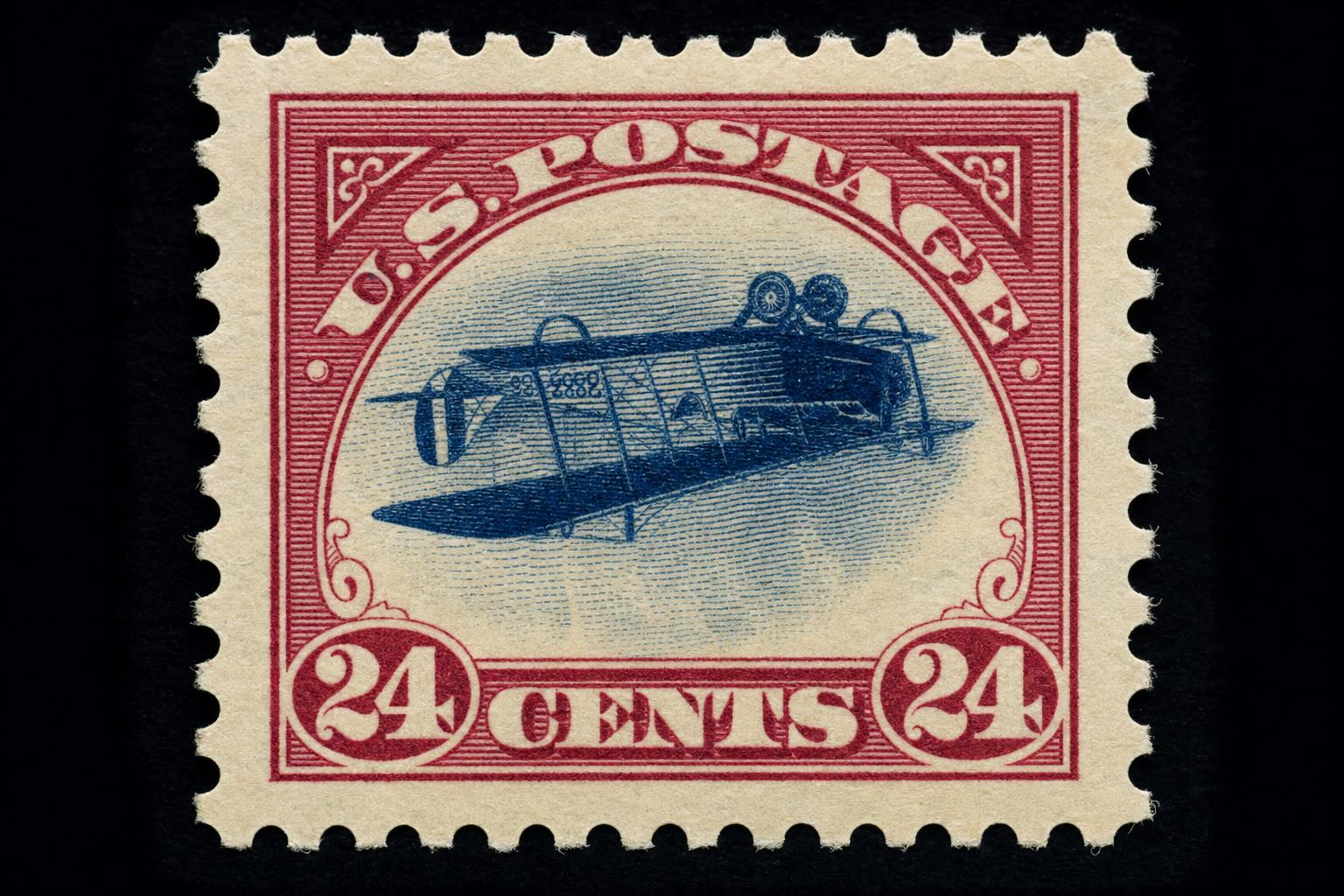
The image is disarmingly simple: a tiny Curtiss JN-4 biplane printed upside down in the center of a 24-cent airmail stamp. It’s not the most ornate or valuable stamp in absolute terms, but the story matters. That single production error—one sheet of 100 stamps—took a routine government issue and turned it into a symbol. Collectors talk about it the way baseball fans talk about a perfect game: you remember where you were when you first saw it.
It’s also a case study in how a technical slip can snowball into legend. Because the stamp was printed in two colors, the blue vignette and the red frame were printed in separate press runs. When the sheet went back through the press, it was fed upside down. That’s the mechanical reality. The myth is what came after: the chase, the dealers, the certifications, the forgeries, and the catalogs that gave the stamp the kind of pedigree most paper never earns.
The Small, Specific Facts That Matter
- Issued in 1918 as a 24-cent airmail stamp to celebrate the beginning of U.S. airmail service.
- Only one sheet of 100 with the airplane vignette inverted is known.
- It was discovered almost immediately after release and quickly dispersed into the collecting market.
Those points are what give the inverted jenny its staying power among famous stamp errors. Each surviving example has a paper trail and a personality—some are hinged, some are mint, many have distinctive cancels. Those individual stories keep the stamp from fading into catalog dryness.
How The Mistake Happened
Printing back then was a multi-step, physical process. Different inks, different plates, separate passes. The frames and centers were on separate plates and required the same sheet to be aligned multiple times. It doesn’t take a dramatic moment for a sheet to go in the wrong way. People forget that industrial slips like this were fairly easy to make and hard to catch, especially when the post office was trying to move large print runs quickly.
What made this error unusual was timing. It was caught early enough that only one sheet made it out into public hands. Had it been caught later, we’d be talking about dozens of sheets and the item would be important but less thrilling. That single-sheet scarcity is what pushes the stamp into the top ranks of rare stamp errors.
The Technology Behind The Error
This wasn’t a smudge or a misperforation; it was a register error. The frame and vignette were printed in separate impressions. The press worker loaded the sheet inverted on the second pass. Result: the airplane upside down.
Few people can look at a modern, one-color laser print and fully imagine the chances for human error in a multicolored, hand-fed process. That’s part of the charm. It’s a mechanical quirk caught and preserved.
William T. Robey And The Discovery Narrative
Stories gravitate to people, and the inverted jenny had a discoverer: a man who recognized the oddity and acted fast. The sheet didn’t sit in a vault for a decade. It was noticed, bought, and then parceled out. That rapid human drama—someone seeing it, realizing what it was, and the scramble that followed—gave the stamp a personality. You can picture the scene: a clerk behind the counter, a customer asking for stamps, and a collector’s eye catching the wrong airplane.
That immediacy is part of why the inverted jenny is more than just a print flaw. It’s a little piece of human timing frozen on paper.
How The Sheet Was Handled
Once the sheet left the post office, it moved through dealers and collectors in a blur. The sheet was broken up fairly quickly; individual stamps changed hands. That dispersal created an entire secondary market where provenance mattered as much as condition. Stamps with documented ownership chains command premiums; the ones that lack that documentation still sell very well because of the design’s fame.
Why It Remains Important To Philately
Collectors value narrative as much as rarity. The inverted jenny brings both. Here’s what it taught the hobby:
- It showed that a printing error could create lasting cultural cachet.
- It accelerated the professionalization of authentication and certification services.
- It created a standard of provenance: where a piece came from and who handled it now shapes detective work in philately.
The stamp also forced collectors and dealers to get serious about forgeries. Because one sheet was worth so much, the market quickly attracted fakes. That prompted more rigorous expertization, catalog updates, and technology-based checks.
The Market: Value, Auctions, And Ownership Patterns
You don’t need a figure to understand the pattern: in the years since that sheet was broken, individual inverted jennys have sold for prices that start in the high five figures and run into the millions. Values fluctuate with condition, centering, whether the stamp is mint or used, and the pedigree that comes with it.
Dealers and auction houses also treat blocks and multiple stamps differently. A block of four from a recognizable position on the original sheet has extra value because it’s rarer than the single examples that were widely dispersed. Collectors compete for those multiples.
Why Some Copies Outperform Others
Condition is the obvious answer, but context matters. A stamp that retains its original gum and shows no hinge marks is rare. A stamp with a clear, contemporary cancel that ties it to its first use may be historically desirable. Then there’s the story: stamps owned by famous collectors or those with impeccable certificates of authenticity carry a premium.
Fakes, Facsimiles, And How Experts Decide What’s Real
Because the inverted jenny is so desirable, forgery work has been sophisticated. Forgers have used printing techniques, subtle color changes, and even thinned paper to mimic originals. The countermeasure has been to develop layers of authentication:
- Expert committees that examine plate flaws, paper, and ink composition.
- Provenance research that ties a stamp to the original sheet positions.
- Technical tests: ultraviolet fluorescence, microscopic examination, and comparison to known examples.
If you plan to buy a high-value example, get a certificate from an established expertizing body and insist on full documentation. Provenance can matter as much as the stamp’s gum.
Common Forgery Tactics To Watch For
Forgers often start with a legitimate 24-cent airmail and attempt to alter it. They might reprint an airplane vignette or manipulate colors. Beware of stamps with suspicious gum or modern adhesives. If a deal seems like a bargain, it most likely isn’t.
The Inverted Jenny And Its Place Among Famous Stamp Errors
It’s easy to name a half-dozen legendary errors around the world, but within U.S. philately the inverted jenny sits near the top. Partly that’s because of its visual clarity—an airplane printed upside down is easy to understand—and partly because of its scarcity. When collectors list famous stamp errors, the inverted jenny is always included. When they talk about rare stamp errors, it’s a benchmark for rarity.
If you want a sense of the stamp’s cultural footprint, look at reproductions. It shows up on posters, in exhibitions, in coffee-table books. The image has become shorthand for the hobby itself.
Condition, Grading, And What Buyers Should Know
Grading a stamp is a mix of objective and subjective assessment: centering, perforations, gum condition, and presence of faults like tears or creases. With the inverted jenny, centering is particularly important because even small shifts can change the eye’s balance. Mint-condition examples with strong centering are scarce.
Buyers should always ask for detailed photographs and a guarantee of authenticity. If a seller can’t supply a recent expert certificate, walk away. Records and transparency are your best protection in a market that attracts both careful collectors and opportunists.
Storage And Display Tips
Keep stamps flat. Use archival mounts, not ordinary adhesives. Avoid bright light and humidity, because paper and gum degrade in the wrong environment. Many museums control temperature and humidity to protect items like this, and serious collectors should do the same.
How The Philatelic Community Treats The Inverted Jenny
This stamp lives in institutions, private collections, and catalog pages. Museums often display one or more examples because it tells a story about American postal history and early aviation. Collectors form syndicates to buy rare examples because the price puts the item out of reach for most single buyers.
Conventions and exhibitions often arrange loans. That’s how people who can’t afford a piece still see it in person. Public exposure keeps the legend alive.
Exhibition Practices And Education
When an inverted jenny is shown, curators try to include documentation: who discovered it, how the sheet was broken, and how the market responded. That context helps amateur collectors understand why the stamp matters beyond its price tag.
Legal And Ethical Issues In High-Value Stamp Trades
With great value comes complex legal questions. Ownership disputes, forged certificates, and disputed provenance can turn a sale into a courtroom drama. The industry has responded by insisting on written guarantees, escrow services for big transactions, and recognized expertizing organizations whose opinions courts tend to respect.
If you’re getting involved at a high level, work with reputable dealers, demand written authentication, and don’t be shy about legal protections.
Comparing The Inverted Jenny To Other Rare Stamp Errors
Other famous U.S. mistakes have their own stories. Some were production flukes; others were design errors. What sets the inverted jenny apart is the combination of visual immediacy, limited quantity, and early discovery. That combination rarely occurs. Some rare stamp errors are prized for the technical curiosity they represent, others for the celebrity of their original owners. The inverted jenny scores in both arenas.
When people compile lists of famous stamp errors, certain traits make the list: clarity of the error, scarcity, an interesting backstory, and a well-documented market history. The inverted jenny checks all those boxes.
Why Some Errors Fade While Others Stay Famous
A misprint that affects tens of thousands of sheets becomes a footnote. A single-sheet error becomes legend. It’s about scarcity, yes, but also about whether collectors and the public can quickly understand the mistake. You don’t need to be a print expert to see a plane upside down. That’s a big part of the stamp’s lasting appeal.
Practical Advice For New Collectors Who Want To Learn From The Inverted Jenny
You don’t need to own one to learn from it. Study how it was authenticated, look at auction catalogues, read up on the printing process, and learn the difference between original gum and regummed examples. Visit exhibitions and talk to dealers. The story of the inverted jenny is a perfect classroom: it touches on production, discovery, the market, and the development of expertizing.
If you eventually want to buy an example, start small. Collecting related items—postal covers, reproductions, or other airmail issues—builds knowledge and taste without the huge financial risk.
Recommended First Steps
- Read specialized catalogue entries and auction descriptions.
- Attend a local stamp club meeting; ask questions.
- Get familiar with expertizing organizations and what their certificates look like.
- Practice spot-checking forgeries: look at gum, paper texture, and color under consistent lighting.
Famous Copies, Oddities, And Small Stories That Keep Things Human
Every surviving inverted jenny has a little quirk. Some have odd cancels. Some are off-center or have tiny faults. Collectors love those details because they make each copy an individual, not just an entry in a catalog. The personalities of these stamps—where they’ve travelled, who owned them, the tiny repairs some underwent—are why the market values provenance as much as centering.
One collector might prize an example with a well-known cancel; another values an untouched mint stamp. Both choices say something about what that collector values.
Why The Inverted Jenny Keeps Drawing New Eyes
Finally, the stamp is a compact story. It’s about technology and human error. It’s about aviation, the postal service, and the moment when a small printed sheet became a cultural touchstone. For collectors and non-collectors alike, that makes it easy to explain, easy to like, and hard to forget. The moment you see a photograph of the inverted jenny, you know exactly what you’re looking at and why people care.
That clarity keeps it in headlines, in auction rooms, and in the catalogs that list famous stamp errors and rare stamp errors for the curious and the committed. It also keeps young collectors curious—what else out there waits to be found, authenticated, and loved? That question is as important to the hobby as any price realized at auction, and the inverted jenny helps keep it alive.
A Single Missed Detail Can Change Everything
Look closely at any reproduction and you’ll spot micro-variations. Plate flaws, tiny breaks in the engraving, slight differences in the airplane’s wing strut—those are the fingerprints experts use to match a stamp to its sheet position. In other words, the joke isn’t that a plane was printed upside down; the real dentification comes from the minutiae that prove authenticity. It’s detective work, and it’s why collectors still get excited when another example resurfaces, even after a century of scrutiny and study. Some finds are modest; some are game-changers. The hobby moves with those discoveries, not summaries.