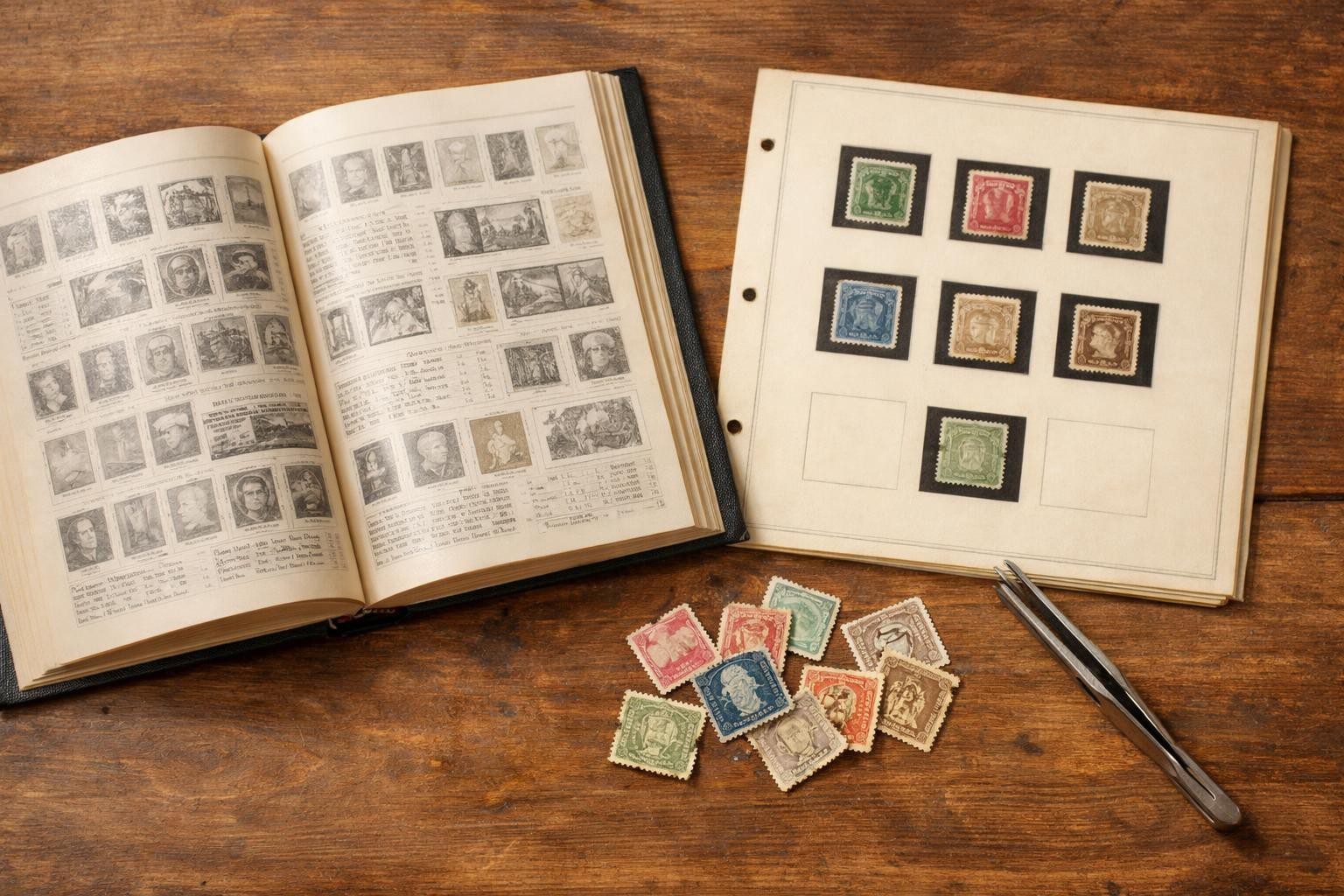
Two catalogs turn up constantly in conversations about what stamps are worth, and they are not the same kind of thing at all. One is a reference work that the whole hobby uses as a common language. The other is a retail price list from a company that wants to sell you stamps. Both are useful. Confusing one for the other is how people end up believing a collection is worth ten times what anyone will pay.
Here is what each one actually is, what each one is good for, and which to reach for depending on what you are trying to find out.
What The Scott Catalogue Is
The Scott Standard Postage Stamp Catalogue, normally shortened to the Scott catalog, is the reference work used as the identification standard for stamps in the United States. The Scott catalog assigns a unique number to every recognized issue, and that Scott number functions as the identifier that dealers, auction houses, collectors and appraisers use when referring to a specific stamp. A stamp described only by its design and its country cannot be priced reliably, while a stamp described by its Scott number can be looked up by anyone.
The Scott catalog records the characteristics that separate one issue from another issue of the same design. Perforation gauge, watermark, paper type, printing method and shade are all recorded, and those characteristics are frequently what separates a common stamp from a scarce stamp. A collection cannot be assessed accurately without reference to a catalog that records those distinctions.
The Scott catalog also carries a value for each issue, and the meaning of that value is the point on which most owners go wrong. Scott catalog value represents a retail price for a sound specimen sold by a dealer to a collector who specifically wants that issue. Scott catalog value does not represent what a dealer pays, and Scott catalog value does not represent what a collection realizes when sold as a lot. Realized prices for common material routinely fall between five and twenty percent of Scott catalog value.
The Scott catalog runs to multiple large volumes covering the world, is revised annually, and is expensive to buy new. Most public libraries hold a recent edition, and a recent edition held at a library is sufficient for nearly every purpose an owner has.
What The Mystic Stamp Catalog Is
The Mystic Stamp Company catalog is a retail sales catalog published by a stamp dealer, and the Mystic Stamp Company catalog is offered free to anyone who requests one. The Mystic Stamp Company catalog lists United States issues with photographs and with the prices at which Mystic Stamp Company is offering those issues for sale.
The prices printed in the Mystic Stamp Company catalog are asking prices in a retail transaction, and asking prices in a retail transaction are the highest figures in the market rather than the ones a seller receives. A stamp offered at a given price in a dealer’s retail catalog will be bought by that same dealer, and by every other dealer, at a considerably lower figure.
Identification by photograph is easier in a catalog with large color images than in a dense reference volume, and a free catalog is accessible to an owner who has no intention of buying a reference work. The Mystic Stamp Company catalog is not useful as a basis for valuing a collection for sale, because a retail asking price from a single dealer is not a market price.
Which Catalog To Use For Which Question
Identification of an unknown stamp is served by either catalog, and the Mystic Stamp Company catalog is frequently faster for United States material because of the photographs. Confirmation of a difficult identification, meaning a case where perforation gauge or watermark must be checked, requires the Scott catalog, because the Mystic Stamp Company catalog does not record those distinctions at the level required.
Comparison of one issue against another issue is served by the Scott catalog, because Scott catalog values are constructed on a consistent basis across the whole catalog and therefore compare reliably against each other even where the absolute figures do not reflect market prices.
Estimation of what a collection will sell for is served by neither catalog. That question is answered by realized prices, meaning completed auction results and recorded dealer sales, and realized prices are the only figures that record what a buyer actually paid rather than what a seller asked.
The Other Catalogs Worth Knowing About
Stanley Gibbons is the standard reference for British and Commonwealth material, and Stanley Gibbons numbers are the identifiers used in the British market in the same way Scott numbers are used in the United States market. Michel is the standard reference for German material and for much of the rest of European material. Yvert et Tellier is the standard reference for French and French colonial material.
A collection containing significant foreign material is assessed more accurately against the catalog standard of the country of issue than against the Scott catalog, because the specialist catalog of a country records varieties that a worldwide catalog condenses or omits.
The One Number That Matters When Selling
Catalog value is a reference figure. Retail value is what a collector pays a dealer. Wholesale value is what a dealer pays you. Those are three different numbers for the same stamp and they can differ by a factor of ten or more. Any appraisal that hands you one figure without telling you which of the three it is has not finished the job.
Send us photos and we will give you two of them in writing. A stamp appraisal is $4.99 for a single stamp and $49.99 for a whole collection, and you get the wholesale figure and the retail figure side by side, plus an offer if we are in a position to make one. Our guide to catalog value versus selling price goes further into why the gap is as wide as it is, and if you already know you want to sell, selling your stamp collection is the next step.