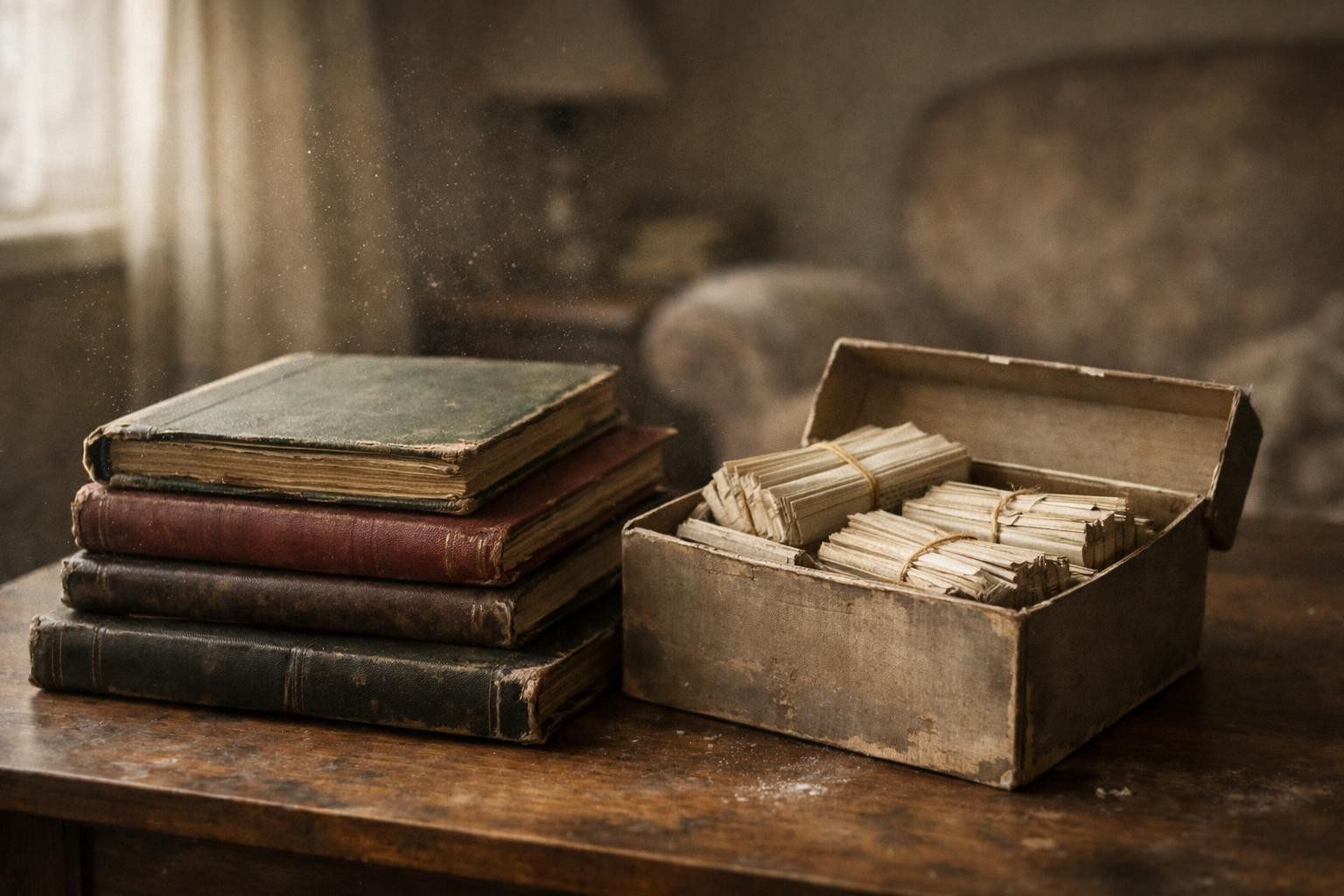
Someone has died, and among the things left behind is a stamp collection. Nobody in the family collects. Nobody knows whether the albums in the closet are worth five hundred dollars or fifty thousand, and nobody wants to be the person who threw away something valuable or spent six months on something worthless.
That situation comes up more than any other in our inbox. The good news is that almost nothing needs to be decided quickly, and the one thing that does need attention in the first week costs nothing to do. What follows is what to handle immediately, what can wait, and the mistakes that are expensive and permanent.
What Needs To Happen In The First Week
Storage is the only genuinely urgent matter. Stamp collections deteriorate in conditions that are common in the places collections are usually found after a death, and deterioration that occurs during the period between a death and a decision is not recoverable afterward.
Humidity causes the gum on unused stamps to activate, which causes unused stamps to adhere to album pages and to each other, and adhesion of that kind destroys the value of the unused stamps affected. Heat accelerates the same process of gum activation and adhesion, and heat is present in most of the locations where an inherited collection is found. Direct sunlight fades printed inks and the fading of printed inks is permanent. Attics, basements, garages and unheated outbuildings are the locations in which inherited collections are most frequently found and are the locations least suitable for storage of a stamp collection.
A collection should be moved into an interior room of an occupied house, kept away from exterior walls and away from windows, and left in the containers in which the collection was found. No further intervention is required during the first week, and no further intervention is advisable.
What Must Not Be Done To An Inherited Stamp Collection
Stamps must not be soaked off paper. A stamp that remains attached to its original envelope is frequently worth several times the value of the same stamp separated from that envelope, because the postal markings, the routing and the date carried by the envelope form part of what is being valued. Separation of a stamp from its original envelope is permanent and the value carried by the envelope cannot be restored afterward.
Stamps must not be removed from albums, and stamps must not be removed from stock books. Removal of stamps from an album or a stock book risks thinning the paper of each stamp removed, and a thin spot in the paper reduces the value of a stamp substantially. Removal also destroys the arrangement of the collection, and the arrangement of a collection is used by an appraiser to assess completeness and to identify what the collector was working toward.
Stamps must not be cleaned by any method and with any substance. Cleaning reduces the value of a stamp in every case, including cases in which the cleaning appears to improve the appearance of the stamp.
A collection must not be sorted by apparent value before a valuation of the collection has been carried out. Sorting performed by a person who is not a philatelist frequently places scarce material into the discard group, because the characteristics that make a stamp scarce are commonly invisible to an untrained observer while the characteristics that make a stamp attractive are highly visible.
Paperwork found alongside a collection must not be discarded at any stage of the process. Purchase receipts, previous appraisals, dealer correspondence, auction catalogs and handwritten inventories establish provenance and record what the collector believed the collection contained. Documentation of that kind is assessed as part of the value of a collection and documentation of that kind cannot be reconstructed once discarded.
Working Out What Was Actually Inherited
Inherited holdings fall into categories that carry very different implications, and the category can usually be determined by inspection without any philatelic knowledge.
An organized collection is held in printed albums with spaces for specific issues, or in stock books arranged by country and by date. An organized collection indicates a collector who worked systematically over a long period, and an organized collection is the category most likely to contain material of consequence.
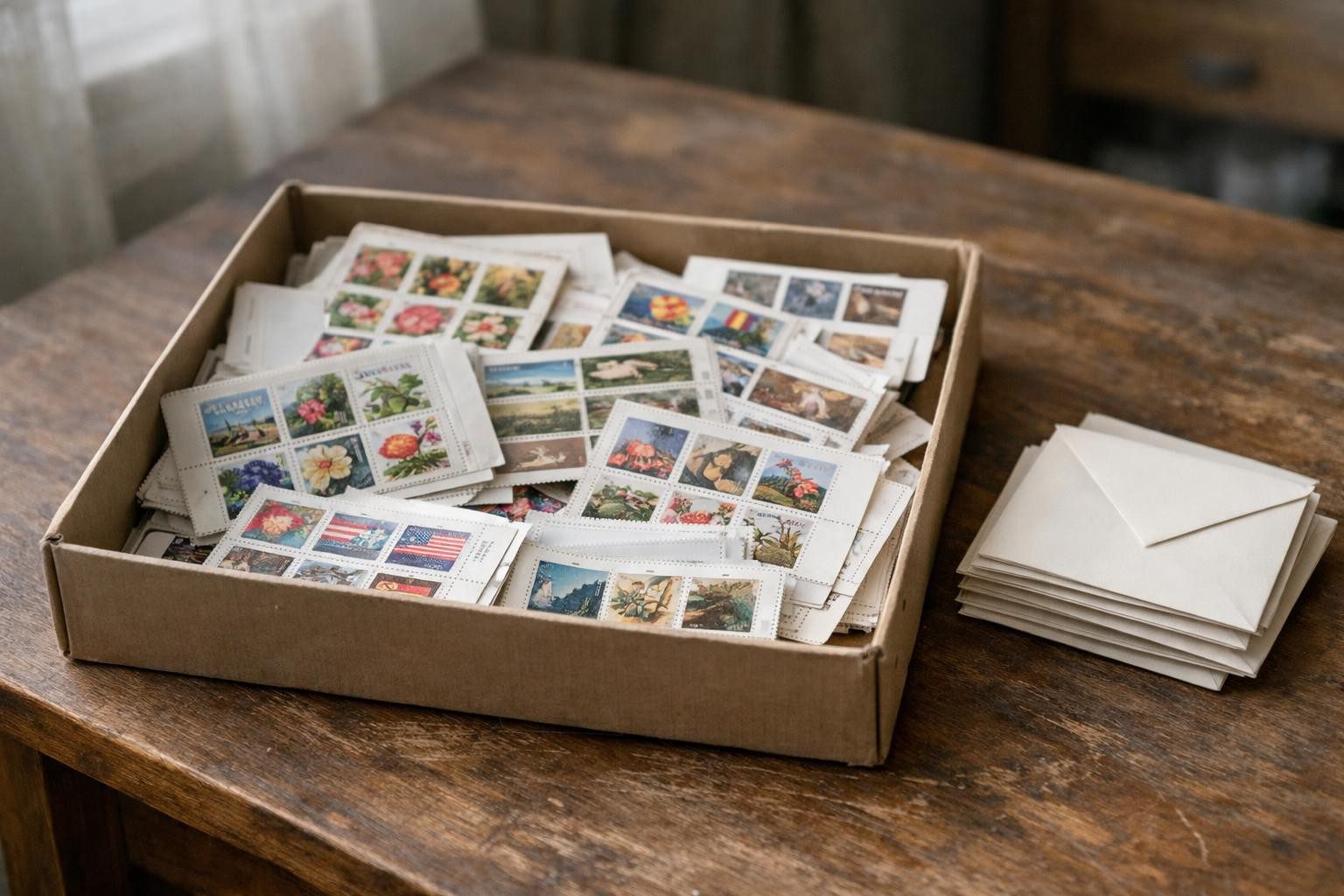
An accumulation is held in boxes, bags, envelopes or tins without arrangement. An accumulation indicates material that was saved rather than collected, and an accumulation is commonly worth considerably less per stamp than an organized collection of comparable size. An accumulation can nevertheless contain individual items of consequence, which is why an accumulation should be examined rather than discarded.
Unused modern postage that remains valid for mailing is a separate category and is valued by face value rather than by philatelic interest. Unused modern postage is purchased at a discount to face value by dealers who resell that postage to mailers.
First day covers produced commercially after approximately 1950 form a fourth category. Very large quantities of commercially produced first day covers survive, and the surviving quantity substantially exceeds current collector demand for commercially produced first day covers.
Whether An Estate Appraisal Is Required
A written appraisal is required whenever a third party must rely on the valuation of a stamp collection. Probate filings require a written valuation stating fair market value at a stated date. Insurance scheduling requires a written valuation that states replacement value for the collection being scheduled. Division of a collection among multiple heirs requires a written valuation that all heirs accept as independent of any one heir.
The valuation basis must be stated explicitly, because replacement value, fair market value and wholesale value applied to the same stamp collection produce figures that can differ by a factor of five. A valuation that states a single figure without stating which basis was used is not usable by an insurer, by an executor or by a court.
Where a probate matter is contested, a USPAP compliant appraisal prepared by a certified appraiser is generally required, and a USPAP compliant appraisal is a distinct and considerably more expensive product than a dealer valuation. Where no third party needs to rely on the figure, a dealer valuation is sufficient and a USPAP compliant appraisal is unnecessary expense.
Deciding Between Keeping, Selling And Dividing
A valuation should precede any decision about disposal, because the appropriate route for disposal is determined by what the collection contains. A collection containing scarce individual items is commonly best served by consignment to a philatelic auction house, where competitive bidding can reach prices that no single dealer would offer for those individual items. A collection consisting predominantly of accumulation material is commonly best served by outright sale to a dealer, because the cost of sorting, lotting and cataloging accumulation material exceeds the proceeds that accumulation material generates at auction.
Division among heirs is complicated by the fact that a stamp collection is frequently worth more as a single holding than as several fragments, particularly where the collection contains complete sets. Sale of the entire collection followed by division of the proceeds commonly produces a larger total for all heirs than physical division of the collection among the heirs.
Retention of an inherited stamp collection is a legitimate outcome, and retention of an inherited stamp collection carries a continuing cost. Storage conditions must be maintained, insurance must be scheduled if the collection carries meaningful value, and the market for twentieth century philatelic material has trended downward over recent decades rather than upward. Retention undertaken in expectation of appreciation is not supported by the price history of the material most commonly found in inherited collections.
Getting An Answer Without Committing To Anything
You do not have to decide anything yet. Move the collection somewhere dry, leave it exactly as you found it, and find out what it is before you do anything else.
Send us photos and we will send back a written appraisal with a wholesale figure and a retail figure, plus an offer if we are in a position to make one. A stamp appraisal is $4.99 for a single stamp and $49.99 for a collection, and the report is yours whether or not you sell and whether or not we make an offer. If you would rather understand the numbers first, our guide to catalog value versus selling price explains why the catalog figure and the offer are so far apart. When you are ready, selling the stamp collection is the next step.
We will also tell you plainly if the collection is not worth pursuing. That answer comes up often, and it is better heard in week one than after six months of effort.