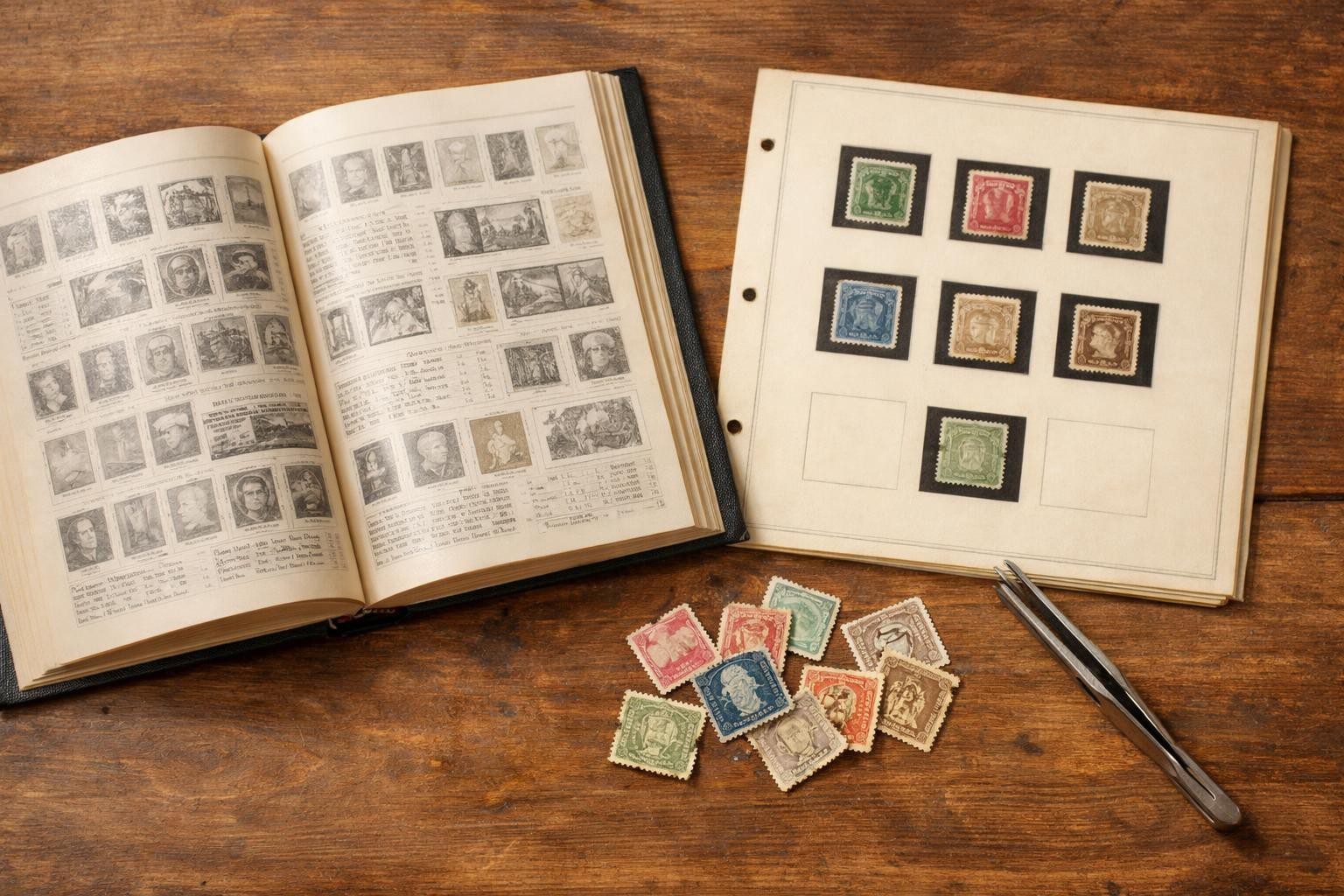
Almost everyone who asks what a stamp collection is worth has already looked up a few stamps and found numbers that seemed too good to be true. A catalog says $340 next to something sitting in a shoebox. A search turns up an auction record for thousands. Neither figure is wrong, and neither figure is what the collection is worth.
The gap between those numbers and reality is not a trick played on newcomers. It is the difference between three separate measurements that happen to be quoted in dollars. Understanding which of the three applies is most of the work, and the rest of this guide covers how each one is arrived at.
The Three Different Numbers A Stamp Collection Has
Catalog value is a reference figure published by a catalog publisher to allow one issue to be compared against another issue. Catalog value assumes a specimen in sound condition sold at retail by a dealer to a collector who specifically wants that issue. Catalog value does not assume a buyer is present, and catalog value does not account for the quantity of that issue currently available on the market.
Retail value is the price at which a stamp actually changes hands between a dealer and a collector. Retail value for scarce material in sound condition approaches catalog value and occasionally exceeds catalog value. Retail value for common material falls far below catalog value, and retail value for common material in poor condition frequently falls to a level at which the material cannot be sold individually at all.
Wholesale value is the price a dealer pays in order to acquire material for resale. Wholesale value is calculated as retail value minus the margin the dealer requires and minus the labor cost of preparing the material for sale. Wholesale value is the number relevant to anyone selling a collection to a dealer, and wholesale value is consistently the lowest of the three figures.
Confusion between catalog value and wholesale value accounts for the large majority of disappointed expectations in this field. A collection carrying a catalog value of ten thousand dollars will very commonly produce a wholesale offer between five hundred and two thousand dollars, and that spread is normal rather than exceptional.
What Determines Whether A Stamp Collection Is Worth Anything
Age is a weak signal
Age correlates with value far less strongly than most owners assume. Enormous quantities of stamps issued between 1930 and 1990 survive in collector hands, and stamps issued in that period were saved deliberately by collectors who expected the stamps to appreciate. Survival in quantity is what suppresses value, and survival in quantity is precisely what happens to material that was saved on purpose.
Material issued before approximately 1900 was not saved systematically, was used for ordinary correspondence, and was discarded in large quantities. Scarcity in the surviving population is the reason nineteenth century material commands the prices that nineteenth century material commands.
Condition sets a ceiling on everything else
Condition is assessed on centering, on the state of the gum where a stamp is unused, on the presence or absence of thin spots in the paper, on the condition of the perforations, and on the clarity of any cancellation. A scarce stamp in poor condition is commonly worth a small fraction of the same scarce stamp in sound condition, and the reduction applied for poor condition is larger for scarce material than for common material.
Faults that are invisible to an owner are routinely visible to an appraiser. Thin spots created by careless removal from an album, creases that do not show at a casual glance, repaired perforations and regummed backs are all detected under normal examination, and each of those faults reduces value substantially.
Completeness raises the value of a set above the sum of its parts
A complete set commonly realizes more than the total of the individual stamps within that set sold separately, because a collector assembling a country or a period will pay a premium to avoid searching for the remaining values. A set missing its highest denomination loses a disproportionate share of the value of the complete set, because the highest denomination of a set is usually the scarcest value in that set and is usually the value the collector still needs.
Provenance and documentation are valued separately
Documented ownership history raises the value of significant items, and certification by a recognized expertizing body raises the value of items whose authenticity would otherwise be questioned. Purchase receipts, previous appraisals and handwritten inventories should be retained with a collection, because documentation of that kind is assessed as part of the value of the collection and documentation of that kind cannot be reconstructed once discarded.
How Much Is My Stamp Worth When Only One Stamp Is Involved
Valuation of a single stamp requires identification of that stamp before any figure can be produced, and identification is the step at which most self assessments fail. Stamps of a single design were frequently issued across multiple years with differences in perforation gauge, in watermark, in paper and in printing method, and those differences are not visible to an untrained eye while those differences can separate a common stamp from a stamp worth several hundred times as much.
Comparison against a photograph found through a search engine establishes the design of a stamp and does not establish the issue of that stamp. Verification of perforation gauge, examination for a watermark and assessment of the paper are required before an identification can be relied upon, and each of those checks requires either equipment or experience.
Estimating A Collection Without An Appraisal
A rough estimate can be produced without professional assistance, and a rough estimate produced without professional assistance should be treated as an indication of order of magnitude rather than as a figure. The method is comparison against realized prices rather than against catalog figures. Completed auction listings and dealer sold records show what buyers actually paid, and completed listings are therefore a more reliable reference than asking prices or catalog figures.
A collection consisting predominantly of used twentieth century material in mixed condition commonly falls below two hundred dollars at wholesale regardless of the number of stamps involved. A collection containing organized country runs with some pre 1940 material commonly falls between two hundred and two thousand dollars at wholesale. A collection containing nineteenth century material in sound condition, or containing scarce individual items, commonly exceeds two thousand dollars at wholesale and requires individual assessment rather than estimation.
Estimation becomes unreliable precisely where the value is highest, because the presence of a single scarce item can move a collection between bands and because scarce items are the items least likely to be recognized by an owner performing an estimate.
When A Written Valuation Is Required Rather Than An Estimate
An estimate is sufficient for deciding whether to keep a collection or dispose of a collection. A written valuation is required where a third party must rely on the figure. Insurance scheduling requires a written valuation that states replacement value for the collection being scheduled. Probate requires a written valuation stating fair market value at a stated date. Division of a collection among heirs requires a written valuation that all parties accept as independent.
The valuation basis must be stated explicitly in any written valuation, because replacement value, fair market value and wholesale value applied to the same collection produce figures that can differ by a factor of five. A written valuation that states a single figure without stating the basis of that figure is not usable by an insurer, by an executor or by a court.
Finding Out What Your Collection Is Actually Worth
If you want a real number rather than a band, send us photos. A stamp appraisal is $4.99 for a single stamp and $49.99 for a whole collection, and you get back a written report with the wholesale figure, the retail figure, and an offer if we are in a position to make one.
We will also tell you when the answer is that your collection is not worth much. That happens often, and hearing it early saves a lot of wasted effort. If the figures look right to you and you want to move, you can go straight to selling your stamp collection, and our guide to catalog value versus selling price goes deeper on why those two numbers diverge.
West Coast Stamp Company has been appraising and buying stamps for more than 30 years, and we are a member of the American Philatelic Society, member number 224675.