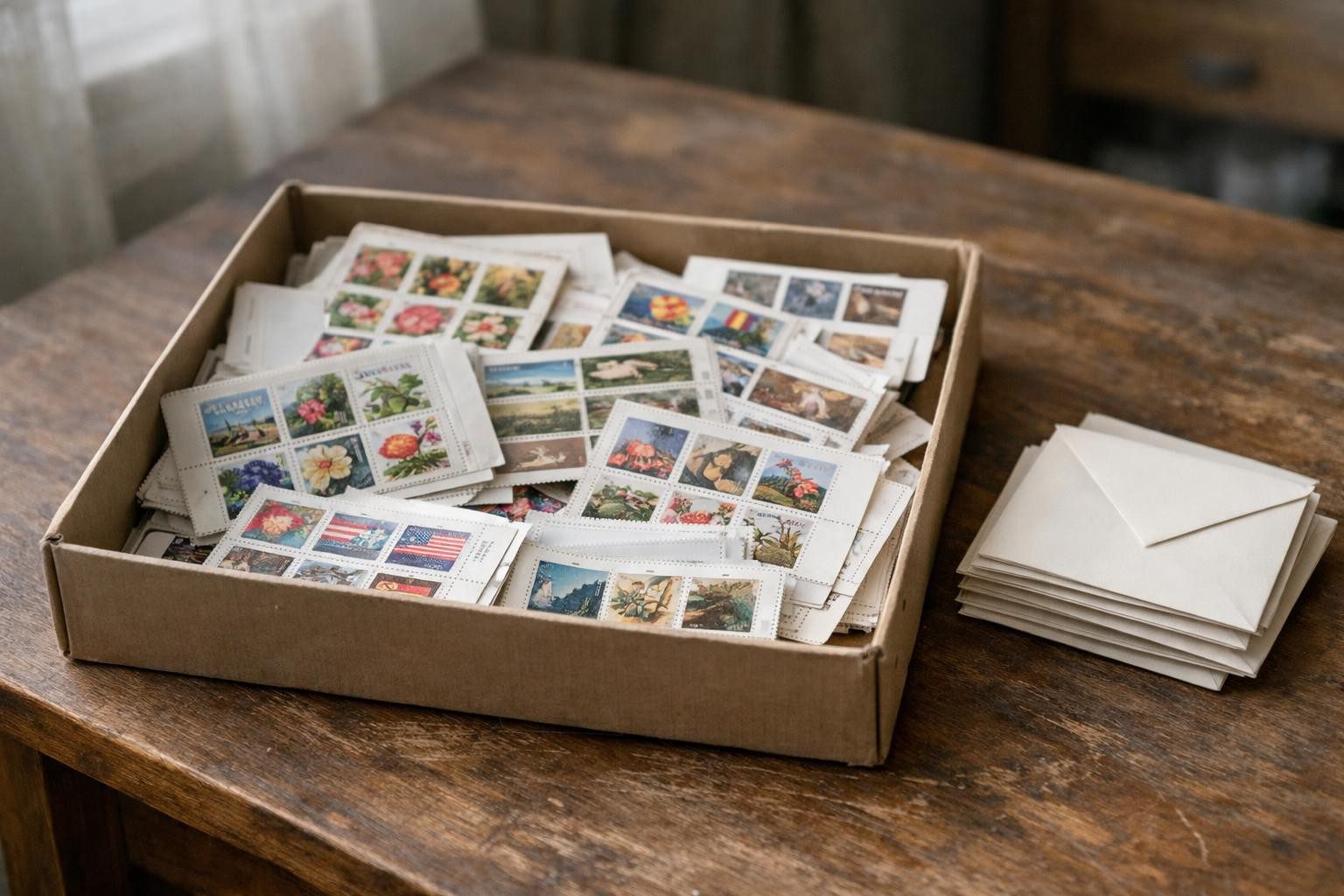
This question arrives from two very different situations. One situation is a desk drawer of unused stamps bought years ago at a lower rate, where the owner of the stamps wants the money back. The other situation is an inherited collection where most of the material is mint and never used, and the Post Office looks like the natural buyer of mint material.
The answer is no, and the answer matters less than the question suggests, because unused postage does not lose value. What follows records what the Postal Service does and does not do with unused postage, what a quantity of unused postage is worth to a buyer of unused postage, and the two routes by which a drawer of unused postage becomes money.
Whether The Postal Service Repurchases Stamps
The United States Postal Service sells postage and the United States Postal Service does not buy postage. No counter at any post office accepts unused stamps from a member of the public and pays cash for those unused stamps, and no program operated by the Postal Service repurchases stamps from collectors or repurchases stamps from estates.
Refund policy for postage products is set by the Postal Service, and refund policy for postage products is revised from time to time, which makes a summary published by a third party unreliable. Anyone whose situation turns on the precise terms of refund policy should consult usps.com directly rather than consult a description published elsewhere, including the description on this page. The general position, unchanged for many years, is that postage sold at retail is not refundable, and the exceptions to that position concern damaged product and misprinted product rather than a purchaser who changed their mind.
Why Unused Stamps Do Not Lose Their Value
Unused United States postage remains valid for mailing indefinitely, and unused United States postage issued at an older rate remains valid at the face value printed on the stamp. A stamp denominated at twenty two cents is worth twenty two cents toward postage today, twenty two cents having been the First Class rate for a one ounce letter from February 1985 until April 1988, and the rate increases that followed 1988 do not reduce the twenty two cents printed on the stamp.
Forever stamps behave differently from denominated stamps, and Forever stamps behave in favor of the owner of the Forever stamps. A Forever stamp carries no printed denomination, and a Forever stamp pays the current First Class rate for a one ounce letter on the day the Forever stamp is used rather than the rate in force on the day the Forever stamp was bought. Forever stamps were introduced in April 2007 at forty one cents, and a Forever stamp bought in April 2007 at forty one cents still pays the full current rate for a one ounce letter.
Denominated stamps issued at older rates are combined to make up current postage, and combining denominated stamps is permitted and is done routinely. The practical constraints on combining denominated stamps are the space available on the envelope and the time taken to apply the stamps to the envelope.
What A Hoard Of Unused Postage Is Worth To A Buyer
A market exists for unused postage that remains valid for mailing, and that market operates at a discount to face value. Dealers in discount postage buy unused postage in quantity, and dealers in discount postage resell that unused postage to businesses and individuals who apply the unused postage to ordinary mail. The margin between the price the dealer pays and the price the dealer charges covers the sorting of the postage, the counting of the postage and the handling of the postage.
Discount postage is valued by total face value rather than by philatelic interest, and the condition that affects a discount postage offer is the condition that affects mailing. Sheets and full panes in sound condition attract stronger offers than loose singles attract, because sheets and full panes require less handling before resale than loose singles require. A total face value composed of low denomination stamps attracts weaker offers than the same total face value composed of high denomination stamps, because low denomination stamps take longer to count and take longer to apply.
Damaged gum, stuck stamps and stamps mounted with hinges reduce the discount postage value of a holding, and damaged gum, stuck stamps and hinged stamps eliminate the discount postage value entirely in severe cases. A stamp that will not adhere to an envelope cannot be used for mailing, and mailing is the only use the buyer of discount postage has for the stamp.
When Unused Stamps Are Worth More Than Their Postage Value
Some unused stamps carry philatelic value above face value, and philatelic value above face value is concentrated in older material rather than in the modern material that fills most drawers of saved postage. Unused United States issues from before approximately 1935, sound and with original gum, are the material most likely to carry value above face value. Unused issues from the decades after 1935 were saved in very large quantities by collectors who expected those issues to appreciate, and the surviving supply of those issues exceeds current collector demand for those issues.
The distinction between postage value and philatelic value matters because the two disposal routes are mutually exclusive. Material sold as discount postage is applied to envelopes and ceases to exist as collectable material. Material carrying philatelic value above face value is therefore identified before any part of the holding is sold as discount postage, because identification after the sale is not possible.
What To Do With A Drawer Of Unused Stamps
Full face value is more than any buyer of unused postage pays, and full face value is returned only by using the unused postage. An owner with ordinary mail to send returns more by applying the unused postage than that owner returns by selling the unused postage.
A quantity too large to use is sold to a dealer in discount postage, and the proceeds of that sale are a percentage of total face value rather than the whole of total face value. Total face value is added up before any buyer is approached, because an offer on unused postage is assessed against total face value and against nothing else.
A holding is examined before either route is taken, because examination before sale is what prevents the expensive mistake, and the expensive mistake is selling material carrying philatelic value above face value at discount postage rates.
Find Out Which Kind You Have
If you are looking at a box of unused stamps and cannot tell whether it is postage or philately, that is exactly the question a stamp appraisal answers. Send photos, and $49.99 gets you a written report on the whole holding with a wholesale figure and a retail figure, plus an offer if we are in a position to make one.
We will tell you plainly if the honest answer is that the holding is worth face value and you should go use it, which is the answer more often than not. If the holding turns out to be worth more than face value, selling the collection is the next step, and our guide to how to sell a stamp collection covers every route and what each route costs.