Almost every collection contains a few stamps the owner is convinced are the good ones. Usually they are the oldest looking, or the most unusual design, or the one that got put in a little envelope on its own by whoever assembled the collection. Almost none of those instincts track what the market actually pays for.
Rarity in stamps is a narrower and more technical thing than it looks. Five factors account for nearly all of it, and once you know what they are you can usually tell within a minute whether something is worth a closer look.
Surviving Quantity Rather Than Original Quantity
Rarity is determined by the number of specimens that survive rather than by the number of specimens that were printed. Stamps printed in the tens of millions for ordinary correspondence in the nineteenth century are scarce today, because stamps used for ordinary correspondence in the nineteenth century were discarded with the envelopes that carried them. Stamps printed in the tens of millions in the second half of the twentieth century are common today, because collectors saved that material deliberately in the expectation that the material would appreciate.
Deliberate saving is what suppresses value, and deliberate saving is precisely what happened to most of the material that people now find in inherited collections. A stamp saved by a million collectors at the moment of issue cannot become scarce, however old that stamp eventually becomes.
Condition Applied Against The Surviving Population
Condition operates as a multiplier on scarcity rather than as an independent factor. A stamp of which ten thousand specimens survive is not scarce, and a stamp of which ten thousand specimens survive but of which only forty are well centered with sound perforations and undisturbed original gum is scarce in that condition.
Condition is assessed on centering, on the state of the gum where a stamp is unused, on the presence or absence of thin spots in the paper, on the condition of the perforations, and on the clarity of any cancellation. The reduction applied for poor condition is proportionally larger on scarce material than on common material, because a buyer of scarce material has the option of waiting for a better specimen while a buyer of common material does not need to wait at all.
Varieties That Are Invisible Without Equipment
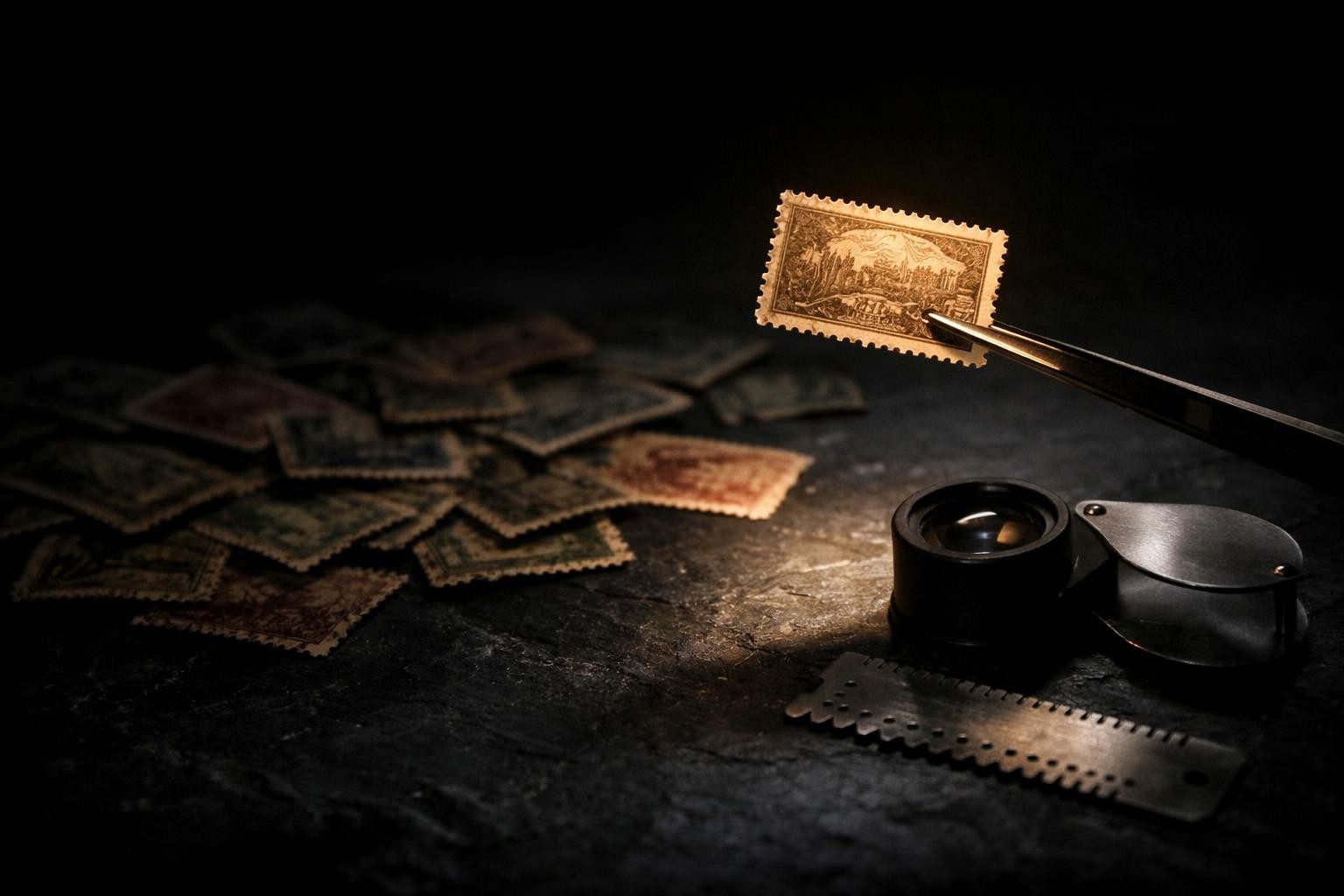
Stamps of a single design were frequently issued across several years with changes to perforation gauge, to watermark, to paper and to printing method. Those changes are not visible to an untrained eye and those changes routinely separate a stamp worth a few cents from a stamp worth several hundred dollars. The differences are recorded in the Scott catalog and are checked with a perforation gauge and a watermark tray.
Comparison against a photograph found through a search engine establishes the design of a stamp and does not establish the issue of that stamp. An owner who has matched a stamp to an image online has completed the easy half of the identification and has not completed the half that determines value.
Genuine Production Errors, Which Are Rarer Than Suspected
Production errors command substantial premiums, and production errors are far less common in collections than owners expect. A genuine error is a stamp that left the printing works in a state the printing works did not intend, such as an inverted center, a missing color, an imperforate pair where perforations were intended, or a double impression.
Most of the stamps presented to us as production errors turn out not to be production errors at all. Perforations shifted within normal tolerance, ink that has faded with exposure to light, paper that has toned with age, and gum that has skipped are all normal production and storage variation rather than error. Perforations trimmed away after issue, whether deliberately or accidentally, produce a stamp that resembles a scarce imperforate variety and is worth less than the ordinary perforated stamp it was made from.
Because genuine errors carry large premiums, genuine errors are also the material most frequently faked. Any stamp that appears to be a significant error should be submitted to a recognized expertizing body before any figure is relied upon, and an unexpertized major error is treated by the market as a probable fake.
Demand, Which Can Disappear
Scarcity produces value only where collectors want the material, and collector demand varies by country, by period and by theme, and collector demand changes over time. Material from a collecting area that is losing collectors falls in price regardless of how few specimens survive, because price is set by the number of buyers competing rather than by the number of items available.
Demand for classic United States material, for classic British and Commonwealth material and for the early issues of most major countries has held up over recent decades. Demand for twentieth century mint commemorative material, for topical collections assembled by theme, and for commercially produced first day covers has declined over the same period. A collection assembled in the 1970s in the expectation of appreciation has in most cases not appreciated, and that is a demand outcome rather than a scarcity outcome.
What Genuine Rarity Looks Like In Practice
The five factors described above are abstract until they are applied to specific stamps, and the stamps most often cited as the great United States rarities illustrate each factor in isolation. The examples below are not offered as material anyone should expect to find, because material of this kind surfaces a few times in a generation. The examples are offered because each one shows a single factor operating at an extreme.
The 1918 24 cent airmail issue known as the Inverted Jenny, catalogued by Scott as C3a, demonstrates the premium attaching to a genuine production error. A single pane of one hundred stamps carrying an inverted center was sold across a post office counter and was recognized immediately by the purchaser, and no further panes carrying the inverted center were released. A single example set a record for a United States stamp when the example realized two million dollars at auction in November 2023. The surviving population is bounded at one hundred specimens by the circumstances of the original sale, and the surviving population is smaller than one hundred because individual specimens have been lost and damaged in the intervening century.
The 1868 one cent issue carrying the Z grill, catalogued by Scott as 85A, demonstrates rarity produced by a variety invisible to an untrained eye. The grill was an impressed pattern applied to stamp paper during a brief period in the late 1860s, intended to break the paper fibers so that cancellation ink would soak in and prevent reuse. Several grill patterns were applied across that period and the patterns differ from one another only in dimensions and spacing. Two examples of the one cent Z grill are recorded, and the two recorded examples are identical in design to a stamp that is otherwise entirely ordinary.
Both examples share a characteristic that matters more than the prices attached to them. Neither stamp is identifiable as valuable from its appearance to someone who does not already know what to look for. The Inverted Jenny is recognizable only because the inverted center is famous, and an owner encountering an inverted center without that knowledge would most likely assume a printing fault of no consequence. The Z grill is not recognizable at all without measurement of the grill pattern.
Age appears in neither case as the operative factor. The Inverted Jenny dates from 1918, which places the Inverted Jenny well inside the period most collections cover, and a great many stamps older than 1918 are worth very little. Rarity was produced in that case by a single error on a single pane rather than by the passage of time.
The Five Factors Applied To Specific Questions
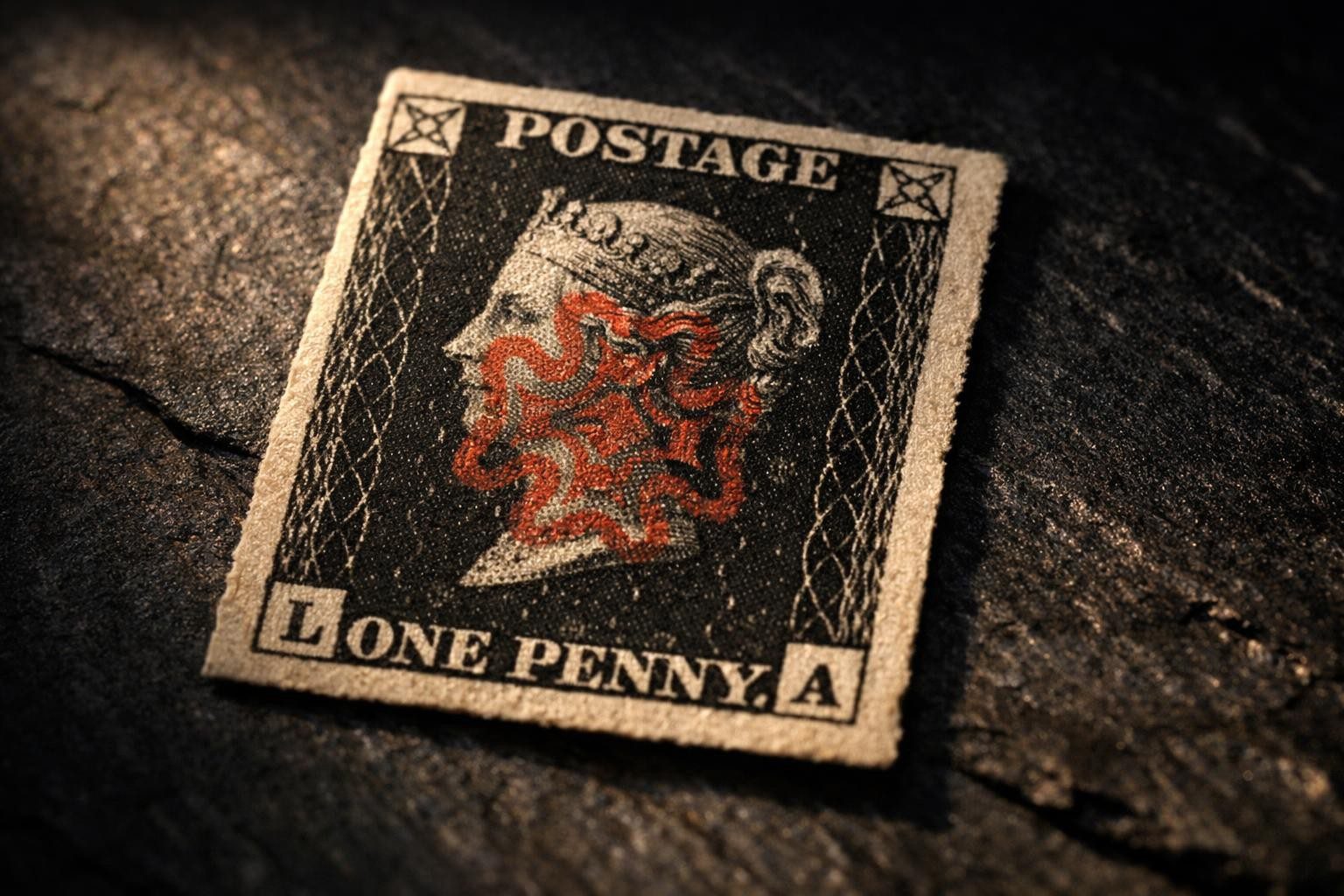
Each of the five factors described above raises a practical question that is covered in more detail elsewhere on this site. The most famous stamp in the world is the clearest demonstration that surviving quantity rather than fame determines price, and what a Penny Black is actually worth sets out the plate and margin factors that decide the figure. Condition is established long before a stamp reaches a buyer, and how a stamp collection should be stored covers the humidity, light and adhesive failures that destroy condition in storage. The housing a collection sits in carries its own risks, and which album type protects a collection explains why hinging reduces the value of unused material. Where a collection proves to be worth a significant sum, insuring a stamp collection covers the sublimits and valuation bases that apply.
What This Means For A Collection In Front Of You
Pre 1900 material in sound condition is where to look first, and the rest of a typical collection is usually worth what it is worth as a whole rather than item by item. If something in yours might be an error, do not let anyone put a number on it until it has been certified.
If you want to know which category yours falls into, send photos. A stamp appraisal is $4.99 for a single stamp and $49.99 for a whole collection, and you get a written report with both a wholesale figure and a retail figure, plus an offer if we are in a position to make one. If it turns out to be the common kind, we will say so, and our guide on catalog value versus selling price explains why that is the usual answer. When you are ready, selling your stamp collection is the next step.