Every album collector faces the same choice: attach stamps with hinges or house them in mounts. The decision affects cost, appearance, and, for mint stamps, value itself. Here is the practical difference, when each is the right call, and the one rule that protects you from an expensive mistake.
What Hinges Are
A stamp hinge is a small strip of glassine with a mild, peelable gum. You fold it, moisten the short flap, attach it to the stamp’s back, and press the long flap to the album page. Hinges are cheap (a few dollars per thousand), fast, and light. Their drawback is permanent: on a mint never-hinged stamp, even a properly used peelable hinge leaves a mark in the gum when removed. That mark moves the stamp from never-hinged to hinged in the eyes of every future buyer.
What Mounts Are
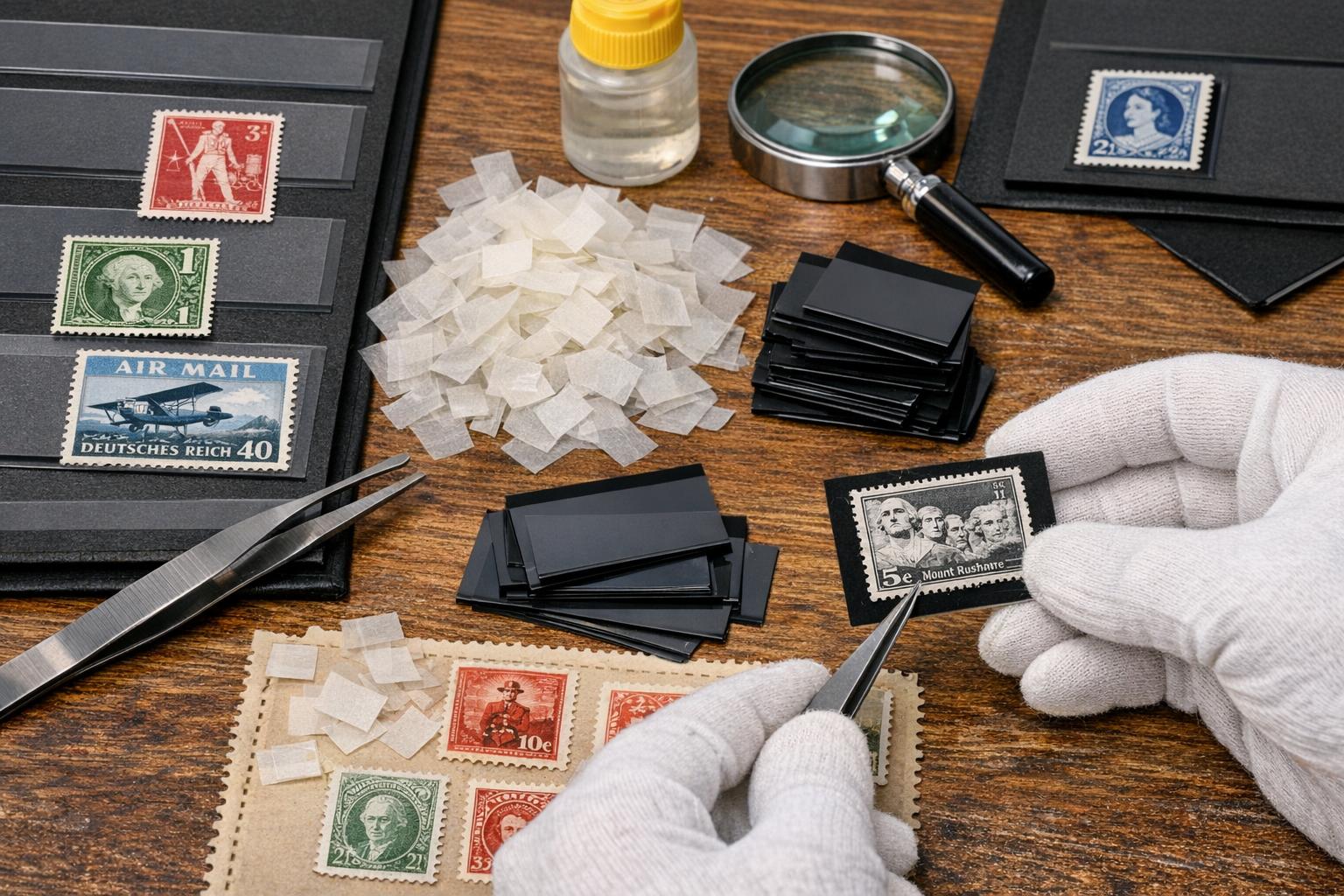
A mount is a clear sleeve, usually black or clear-backed polyester or polystyrene, that holds the stamp without anything touching its gum. The mount attaches to the page; the stamp just sits inside. Mounts cost meaningfully more than hinges and add bulk to album pages, but the stamp comes out exactly as it went in.
The Rule That Matters: Gum Is Money
For mint stamps, the market pays a premium for undisturbed original gum, and on classic material the never-hinged premium can be a multiple of the hinged price. That leads to a simple decision rule. Use mounts for mint stamps where the gum carries value, which in practice means any mint stamp you care about and certainly anything scarce. Use hinges freely for used stamps, where there is no gum to protect and the hinge mark is irrelevant, and for inexpensive material where mount cost outweighs the stamps’ worth.
Most experienced collectors run both systems in the same album: mounts for the mint pages, hinges for the used. That is not indecision; it is matching the cost of protection to the value being protected.
When Mounts Earn Their Cost Beyond Gum
Mounts also protect against handling: the stamp is shielded from fingers, moisture, and abrasion every time the album opens. For high-value used stamps (a used classic worth real money still deserves protection even without gum), souvenir sheets, and anything you display, mounts are worth it regardless of the gum question. Choose the correct size so the stamp neither curls inside an oversized mount nor gets forced into a tight one, and buy mounts from philatelic suppliers so the plastics are archival; ordinary household plastics can damage stamps over time, as covered in our stamp storage guide.
Using Each Correctly
With hinges, moisten the flap lightly (a barely damp fingertip, not a lick that floods the gum), place the hinge near the top of the stamp’s back, and never try to remove a hinge until it is fully dry; pulling a damp hinge is how thins happen. With mounts, cut or select the right size, moisten only the mount’s own gum or use self-adhesive backing, and insert the stamp with tongs.
If You Inherited an Album Full of Hinged Stamps
Leave it alone. Removing old hinges is one of the most common ways collections get damaged, and the hinge marks are already priced in. If the collection might have value, have it appraised as-is; we would much rather see original hinges than fresh thins.