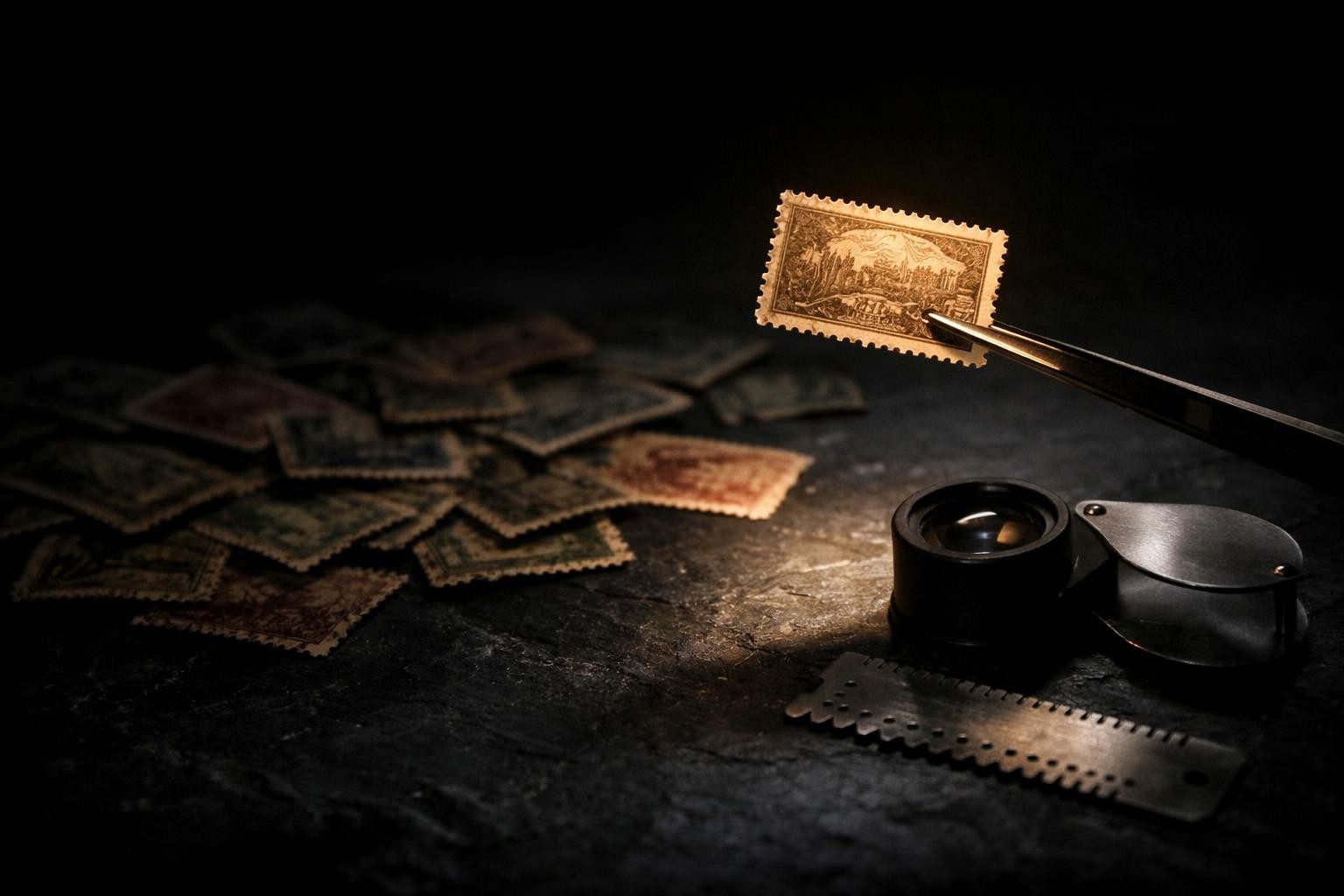
The Penny Black turns up in inherited collections more often than people expect, usually in a glassine envelope marked “RARE” in a previous owner’s handwriting. It is the first adhesive postage stamp any country issued, it is the most recognizable stamp in the world, and it is almost never the valuable item in the box.
Famous and rare are not the same thing. The Penny Black is the clearest example of the difference anywhere in philately, and understanding why explains most of what drives stamp values generally.
What The Penny Black Is And How Many Were Printed
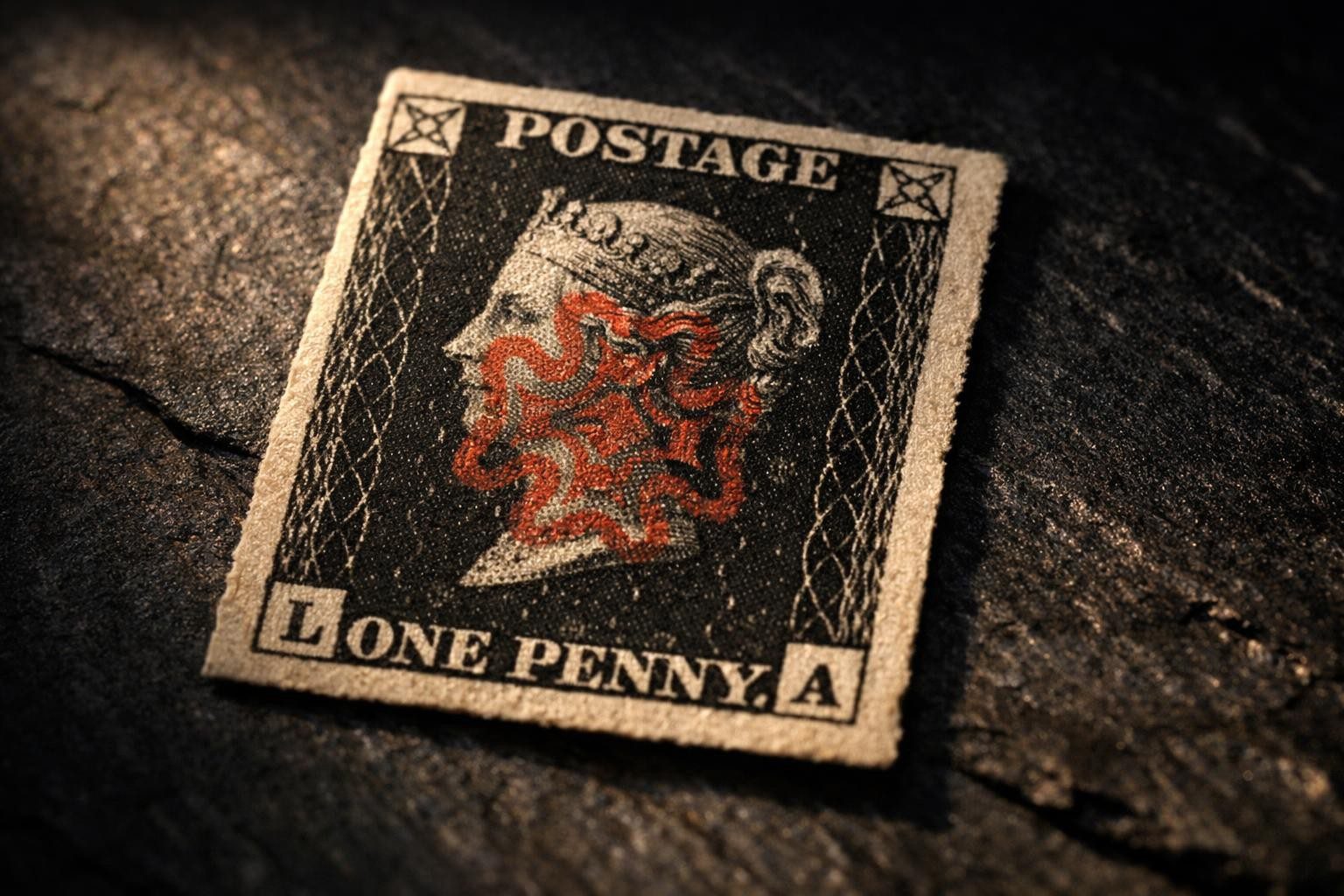
The Penny Black was issued on 1 May 1840 and was valid for postage from 6 May 1840, as part of the postal reform associated with Rowland Hill. The stamp carries a portrait of Queen Victoria derived from a medal engraving by William Wyon. Printing was carried out by Perkins, Bacon and Petch, and printing continued until the Penny Black was withdrawn in favor of the Penny Red early in 1841.
Approximately 68,808,000 Penny Blacks were printed during that period of roughly nine months. A print run of 68,808,000 for a single design is large by the standards of any era, and a print run of 68,808,000 is very large indeed for a stamp issued in 1840. The figure matters because rarity is a function of how many specimens survive, and the number of specimens that survive is bounded by the number of specimens that were produced.
Survival Rates Kept The Penny Black Common
Most nineteenth century stamps were discarded with the envelopes that carried them, which is why so much ordinary nineteenth century material is scarce today. The Penny Black is the exception to that pattern. The Penny Black was recognized as a novelty from the moment of issue, and the Penny Black was saved deliberately by the people who received it, in quantities no other stamp of the period matched.
Deliberate saving at the moment of issue is the single most reliable way to prevent a stamp from ever becoming scarce. Published estimates of the number of surviving Penny Blacks vary considerably between sources and no single authoritative count exists, so a precise figure is not given here. What is not in dispute among dealers and auction houses is that used Penny Blacks remain readily available for purchase at any major stamp auction in any given month.
Plate Number Separates An Ordinary Example From A Valuable One
The Penny Black was printed from eleven plates, designated Plate 1a through Plate 11. Each stamp carries two letters in the lower corners which record the position that stamp occupied on its sheet, and the combination of those corner letters with the characteristics of the printing allows a specialist to attribute a given Penny Black to a given plate.
Plate attribution produces very wide differences in value. Plates that remained in use for long periods produced large quantities of stamps and the stamps from those plates are correspondingly common. Plate 11 was used only briefly before the changeover to the Penny Red, and material from Plate 11 is scarce as a direct consequence of that brief period of use. An owner who does not know which plate a Penny Black came from does not yet know what that Penny Black is worth.
Margins Matter More Here Than On Almost Any Other Stamp
The Penny Black was issued imperforate, which means the sheets carried no perforations and individual stamps were separated with scissors by whoever used them. Separation by scissors was performed by clerks and members of the public rather than by machine, and separation by scissors produced enormously variable results.
Because every Penny Black was cut by hand, the width of the blank margin around the printed design varies from specimen to specimen, and that variation is the dominant condition factor for this issue. A specimen showing four clear margins on all four sides commands a substantial premium over a specimen where the scissors cut into the printed design on one or more sides. A specimen cut into the design on two sides is a damaged stamp in market terms regardless of how clean the rest of it looks.
Cancellation Appearance And Why The Penny Black Was Replaced
Penny Blacks were cancelled with a Maltese Cross handstamp, applied in red ink during the earliest period of use. A red cancellation on a black stamp proved difficult for postal clerks to see clearly, and a red cancellation on a black stamp also proved possible to remove, which allowed stamps to be cleaned and presented for reuse.
The Penny Red was introduced in 1841 to address both problems at once, because a black cancellation applied to a red stamp is both easier to see and considerably harder to remove. For a collector the practical consequence is that the color and clarity of the cancellation affect value, and a light, well struck cancellation that leaves the portrait visible is preferred over a heavy cancellation that obscures the design.
Reprints, Forgeries And Pressed Reproductions
Reproductions of the Penny Black have been produced continuously since the nineteenth century, for sale as souvenirs, as album space fillers and as deliberate forgeries. Many reproductions are marked as reproductions on the reverse, and many reproductions are not marked at all. Material of this kind circulates widely in general estate lots and in accumulations assembled by people who were not collectors.
A genuine Penny Black of any significant value should be examined by a specialist before a figure is relied upon. The combination of worldwide name recognition and very large numbers of reproductions means that the Penny Black is among the stamps most frequently misidentified by owners who are working from a photograph rather than from the stamp itself.
What Yours Is Probably Worth
Most Penny Blacks that come through our door are used, cut close on at least one side, and from a common plate. Those are worth real money, just not life changing money, and the number depends almost entirely on margins and plate rather than on age.
If you have one, send a photo of the front and the back. A stamp appraisal is $4.99 for a single stamp, and you get a written report with the plate attribution where it can be established, a wholesale figure and a retail figure. Our guide to what actually makes a stamp rare covers why the famous ones so rarely top the list. If the Penny Black came with a wider holding, selling the whole stamp collection is usually the better route than breaking it up.