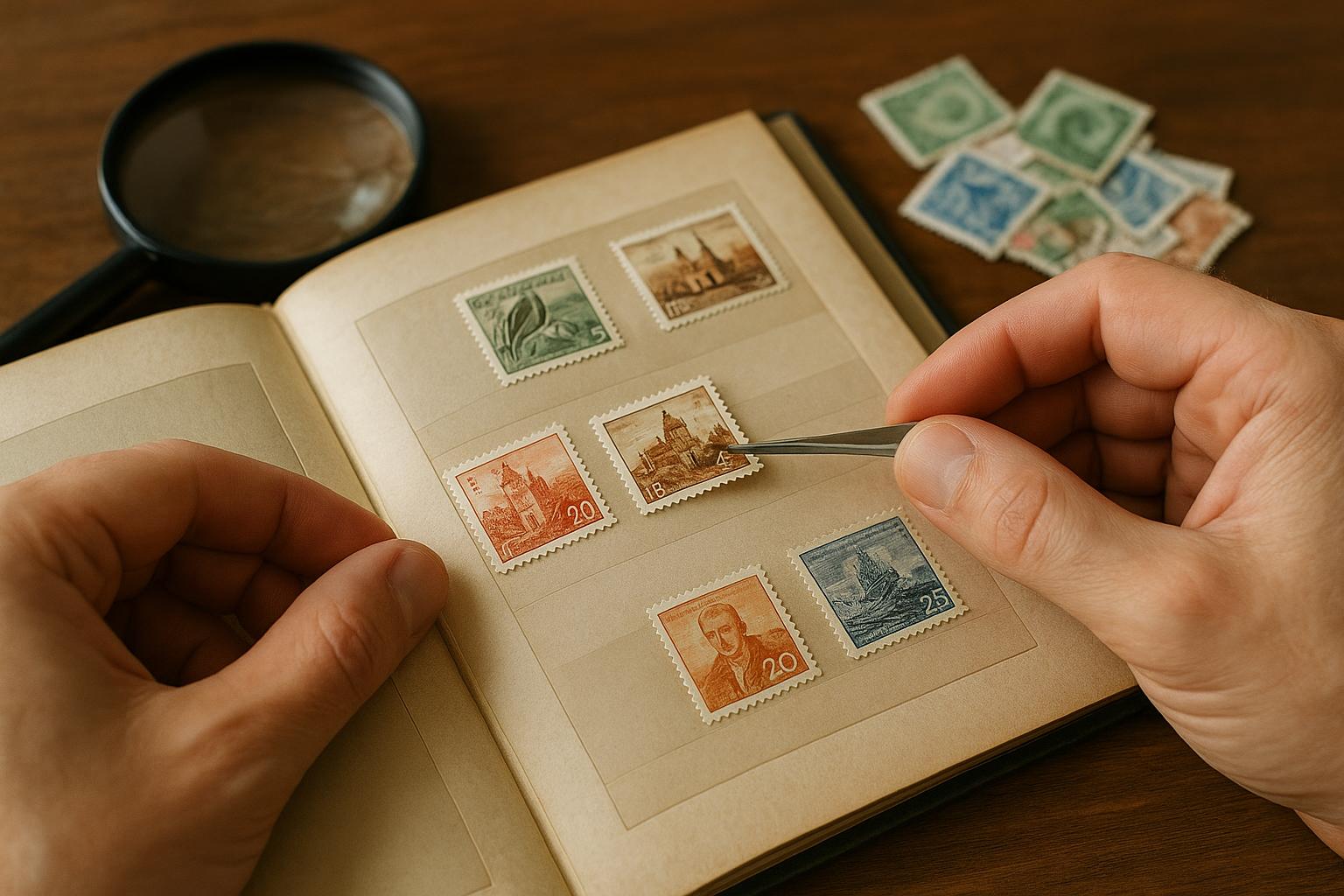
Stamp collecting needs no permission, no big budget, and no prior knowledge. It needs a shoebox of stamps, a few basic tools, and curiosity. This is the complete starter guide: what to collect first, the tools worth buying, mint versus used, albums versus stock books, how to store loose stamps, and the one measuring tool that unlocks identification. Everything a new collector needs is on this page.
Start by Collecting Anything, Then Narrow
The classic beginner mistake is trying to collect everything forever. Start wide on purpose: accumulate whatever crosses your path (mail, dealer mixture packets, a relative’s shoebox) and notice what holds your attention. Within a few months most collectors gravitate somewhere: a country, an era, a topic like birds or space, or a format like coil stamps. Narrowing is what turns a pile into a collection, and choosing the focus yourself is half the fun.
What should you save first? Save everything at the start; common stamps cost you nothing to keep and teach you identification for free. Prioritize keeping stamps in the best condition you find them, complete sets when you can get them, and older material from before roughly 1940, which is where scarcity begins to live. Do not spend real money on “rare” stamps until you can verify what makes them rare; our guide to whether old stamps are worth anything explains the signals.
The Starter Toolkit (Under 50 Dollars)
Five tools cover a beginner’s needs. Stamp tongs, the smooth-tipped tweezers made for stamps, protect paper from skin oils; never substitute household tweezers. A magnifier (a 10x loupe) reveals the details that identify and grade stamps. A perforation gauge measures the teeth along stamp edges; perforation count separates otherwise identical stamps, and using the gauge is as simple as sliding the stamp along the scale until the dots align with the holes. Watermark fluid and a small black tray reveal the hidden marks in stamp paper, covered fully in our watermark guide. And glassine envelopes hold sorted stamps safely for pennies each.
Mint or Used? Both, and Here Is the Difference
Mint stamps (unused, with gum) show the stamp as issued and carry a premium for undisturbed gum. Used stamps carry postal history: real mail, real cancellations, often at a tenth of the mint price or less. Beginners get more collection per dollar from used stamps, and there is no wrong answer; many collectors keep both and let their specialty decide later. What matters at the start is condition either way: a clean, well-centered used stamp beats a creased mint one. Learn what damages value early by skimming our stamp faults guide; knowing what a thin is will save you from creating one.
Album or Stock Book?
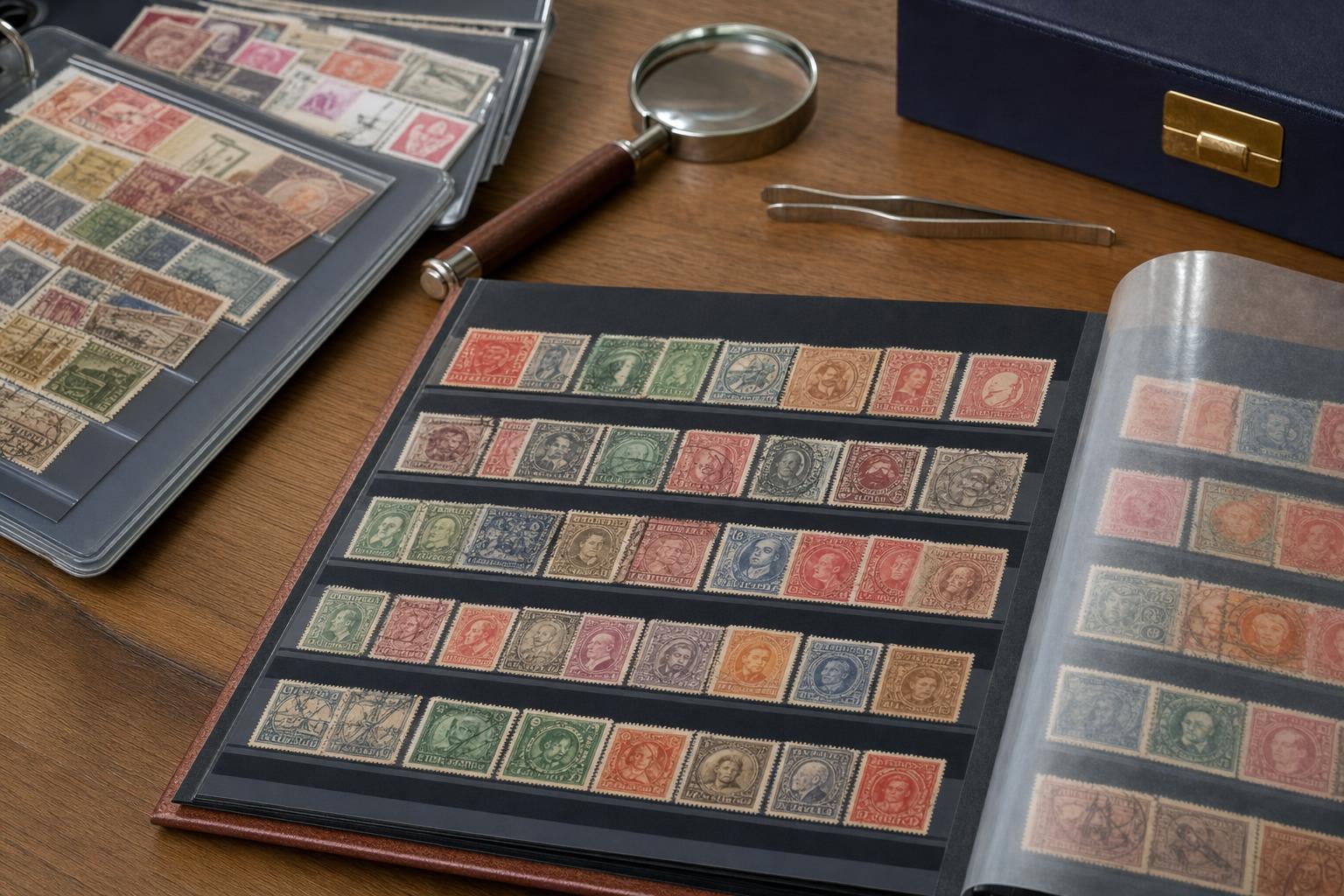
A printed album gives every stamp a labeled home and shows you the gaps to fill; it suits collectors who like structure and a defined goal. A stock book (pages of clear horizontal strips) accepts any stamp in any order instantly; it suits accumulators, topical collectors, and everyone’s duplicates. The honest answer for a beginner is a stock book first, because your focus will change and stock books forgive that. Add a printed album once you know what you collect. Attach stamps with mounts or hinges as appropriate; the difference matters for mint material and is explained in our hinges versus mounts guide.
Storing Loose Stamps Before They Are Mounted
Every collector runs a backlog of unsorted material. Keep it in glassine envelopes or stock cards, labeled by source or country, inside a closed box away from light and damp. Never store loose stamps in rubber-banded stacks, ordinary paper envelopes that can transfer acid, or anywhere humid; stamps stuck together by moisture usually cannot be separated undamaged. The full environmental rules (temperature, humidity, sunlight, materials) are in our storage and preservation guide, and stamps still on envelope paper can be freed safely using the soaking method.
Learning to Identify What You Have
Identification is the skill that turns collecting into a hobby with depth. The workflow: match the design to a country and series, then confirm the specific variety by checking perforation, watermark, and printing details against a catalog listing by its Scott number. Common stamps teach this skill as well as rare ones, which is another reason to keep everything early on.
Joining the Hobby
Collecting alone works, but the hobby is faster and friendlier with company. The American Philatelic Society maintains a directory of local clubs, most metro areas hold periodic stamp shows where dealers sell material at every price point, and our guide to finding stamp collectors near you covers where to look.
When Your Collection Grows Up
Sooner or later most collectors buy better material, inherit an accumulation, or wonder what their albums are worth. When that day comes, condition and correct identification decide everything, and a professional opinion beats guessing. Get a stamp appraisal whenever you want a straight answer about what you have.
Leave a Reply