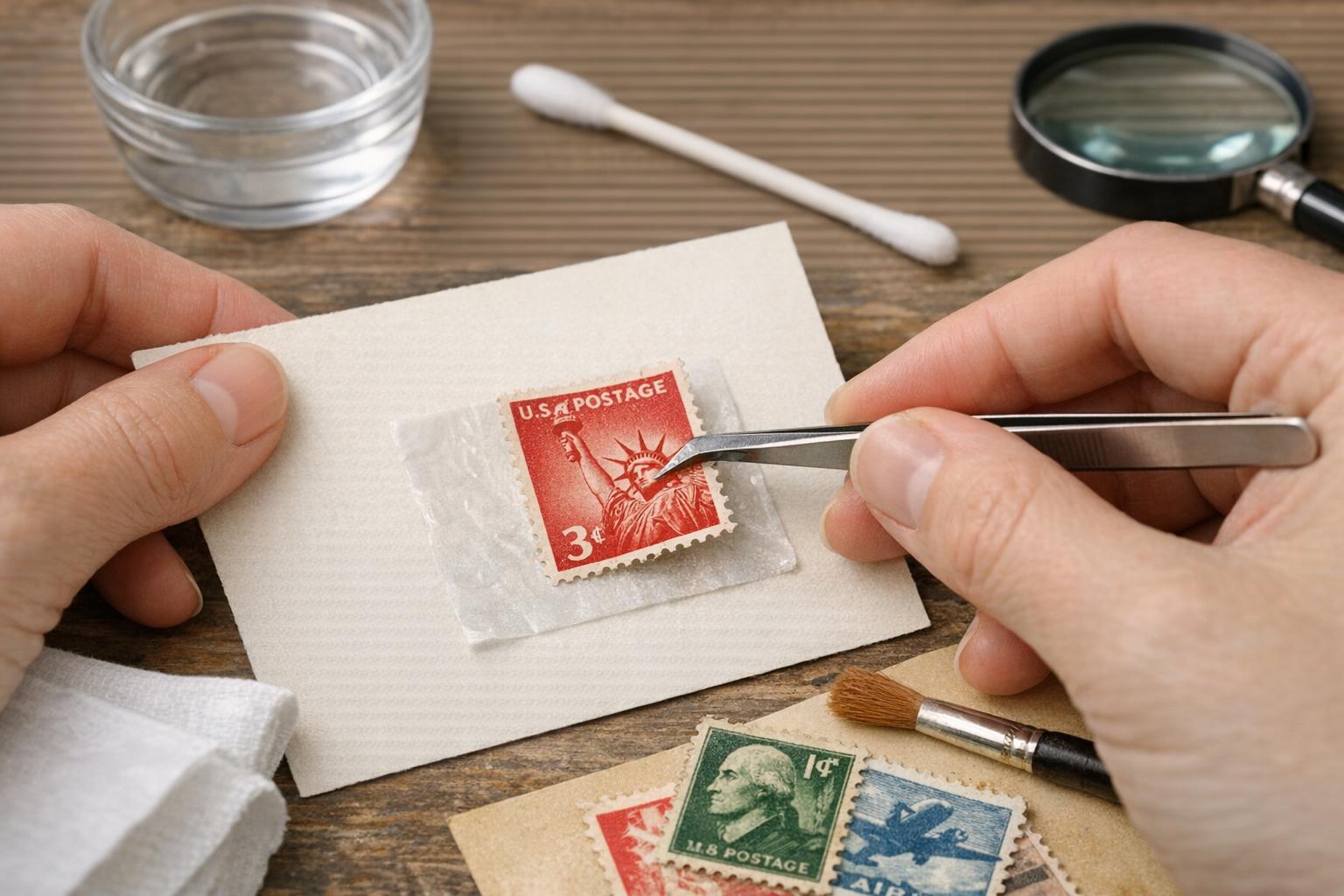
This article explains how to remove a stamp from paper safely, preserving both the stamp and the paper substrate while minimizing damage to inks and adhesives.
## How To Remove A Stamp From Paper Safely: Care Tips
Before attempting any extraction, determine the stamp’s value (monetary or sentimental), the paper type, and the nature of the adhesive. Proper assessment reduces the likelihood of loss. Successful stamp removal requires an understanding of water-soluble adhesives, pressure-sensitive adhesives, and the effects of moisture and solvents on inks and paper sizing. When executed with caution, how to remove a stamp from paper safely combines appropriate tools, stepwise testing, and conservative technique.
### Risks And Suitability For Different Papers
Not all paper stocks tolerate moisture or mechanical manipulation. Laid, ribbed, or highly sized papers and documents with iron-gall ink or fugitive dyes may discolor, bleed, or delaminate. Vintage papers with brittle fibers are particularly vulnerable. Evaluate:
– Paper strength and flexibility.
– Ink stability (test an inconspicuous edge).
– Whether the stamp is printed or hand-canceled (hand-cancel ink often reacts differently).
Adhering to careful assessment is central to responsible stamp removal and to sound paper stamp care.
### When To Avoid Attempting Removal
Avoid attempting removal if the stamp is on a legal document, historical manuscript, or any paper that would lose context when separated. If the item appears fragile or of significant collector value, consult a paper conservator. Amateur attempts may irreversibly harm both stamp and substrate.
## Tools And Precautions For Safe Stamp Removal
Good practice for stamp removal includes wearing nitrile gloves to avoid oils, working on a clean flat surface, and having magnification available. Maintain a log of tests and procedures in case professional treatment becomes necessary. The following materials are commonly used for controlled stamp removal and subsequent paper stamp care:
### Materials Required For Remedies
– Distilled water (room temperature and warm)
– Shallow trays or glass dishes
– Soft, lint-free tweezers
– Blotting paper and archival-weight drying boards
– Weights (non-acidic glass or clean metal bars wrapped in archival tissue)
– Freezer (domestic is acceptable)
– Small artist’s brush or micro-spatula
– Solvent options (heptane or commercial adhesive erasers) — use only with expertise
– pH-neutral, archival storage sleeves and mounts
Use these materials only after confirming paper and ink stability. Always test on a small, unobtrusive area.
### Remedy 1: Warm Water Soak Method
Materials:
– Distilled warm water (approximately 30–35°C / 86–95°F)
– Shallow glass dish
– Soft tweezers
– Blotting paper
– Archival drying board
Procedure:
1. Test: Moisten a corner of the paper near the stamp with distilled water using a cotton swab to confirm there is no ink bleeding or paper collapse.
2. Prepare: Fill a shallow dish with distilled warm water. Place the item so that the stamp area is just immersed; never submerge delicate documents without prior testing.
3. Soak: Allow the stamp to loosen for 30 seconds to 2 minutes. Monitor continuously. Adhesive dissolution rates vary by era and adhesive type.
4. Separate: When the adhesive begins to release, use soft tweezers or a micro-spatula at an extremely shallow angle to ease the stamp from the paper. Proceed very slowly; stopping and re-soaking is preferable to applying force.
5. Rinse: If the stamp and paper tolerate it, briefly rinse in fresh distilled water to remove residual adhesive.
6. Drying: Place the stamp between blotting paper and put under gentle weight to dry flat. Replace blotters as necessary until fully dry. For paper stamp care, ensure drying is gradual to prevent cockling.
Notes: The warm water soak method is the least invasive for traditional water-soluble gum. It is often the first, conservative approach recommended when learning how to remove a stamp from paper safely.
### Remedy 2: Freezer And Adhesive Hardening Method
Materials:
– Freezer compartment
– Thin protective film (Mylar or polyethylene)
– Micro-spatula or dental pick
– Tweezers
Procedure:
1. Encapsulation: Place the document inside a thin protective sleeve so moisture transfer is minimized. The protective film also prevents frosting of the stamp surface.
2. Freeze: Lay the sleeved item flat in the freezer for several hours. The cold renders some pressure-sensitive adhesives brittle and easier to separate.
3. Test Separation: Remove the item and, while still cold, attempt to lift an edge of the stamp with a micro-spatula. Work incrementally; the adhesive may shatter or separate.
4. Extraction: If separation begins, continue gently. If the stamp resists or fibers tear, re-freeze and reassess.
5. Post-Extraction Care: Allow both stamp and paper to gradually return to room temperature inside the protective sleeve to avoid condensation. For continuing paper stamp care, flatten and store as above.
This technique is particularly useful for modern self-adhesive labels where heat or water would cause deformation or adhesive migration. The freezer method provides a non-chemical alternative when practicing how to remove a stamp from paper safely.
### Remedy 3: Solvent-Assisted Separation (Use With Caution)
Materials:
– High-purity solvent (heptane recommended for pressure-sensitive adhesives)
– Cotton swabs
– Glass stirring rod
– Fume-ventilated workspace
– Nitrile gloves and eye protection
Procedure:
1. Preliminary Testing: Apply a solvent-dampened swab to a marginal area to verify that inks and paper sizing are unaffected. Solvents may dissolve inks or coatings.
2. Application: Apply solvent sparingly to the adhesive interface using a swab or micro-syringe. Avoid soaking. Allow the solvent to penetrate briefly.
3. Separation: Using a micro-spatula, gently coax the stamp away from the paper. If the adhesive softens, work progressively around the stamp perimeter.
4. Neutralization: Once removed, ventilate and allow residual solvent to evaporate completely. Do not use water to remove hydrocarbon solvents.
5. Conservation: Because solvent use is high risk, retain detailed notes of the solvent type and exposure time for future conservators engaged in paper stamp care.
Solvent-assisted methods are a last resort for adhesives that do not respond to water or cold. They require formal precautions and are best executed by an individual trained in conservation techniques due to potential permanence of solvent effects.
### Paper Stamp Care And Post-Removal Handling
After any extraction, both the stamp and the backing paper require attentive aftercare. Flatten stamps under archival blotters and weights only when fully dry. Store in acid-free sleeves and use mounts that prevent movement but allow air exchange. For stamps that have lost original gum, avoid attempts to re-gum at home; re-gumming alters provenance and collector value.
For continued preservation, maintain stable environmental conditions: relative humidity around 40–55% and a temperature near 18–21°C (65–70°F). Excessive humidity can lead to adhesive reactivation, while low humidity may embrittle fibers. These conditions are central to disciplined paper stamp care.
### Frequently Asked Questions About How To Remove A Stamp From Paper Safely
Q: Is stamp removal reversible?
A: Partial reversibility depends on technique and materials. Water-soaked stamps may re-adhere or discolor; solvent effects can be irreversible. Documentation during the process is essential when attempting how to remove a stamp from paper safely.
Q: Can modern self-adhesive stamps be removed intact?
A: In some cases yes, using freezing or solvent methods. However, modern adhesives are designed for permanent attachment; success rates vary. For high-value items, seek professional advice before any attempt at stamp removal.
Q: Will removal reduce collector value?
A: Alterations such as regumming, thinning, or ink loss often reduce value. Professional conservation may mitigate these effects, but do not assume preservation of original characteristics. Approaching removal only when necessary is a key principle of how to remove a stamp from paper safely.
Q: When should I consult a conservator?
A: Consult a conservator for historically significant documents, fragile papers, or any item whose value outweighs the risk of home methods. Professional assessment upholds best practices in stamp removal and long-term paper stamp care.
Leave a Reply